Amari Bailey is attempting something unprecedented in modern college basketball: returning to the NCAA after appearing in NBA games. We’ve had players that have stayed in the NBA draft or were drafted, and been in camp, trades, and summer league, but never an actual NBA player. The legal implications are significant and would farther breakdown doors, the NCAA’s opposition is clear, and the outcome could further erode the already-fragile distinction between college and professional basketball.
But while the eligibility question dominates headlines, it’s not the most interesting part of Bailey’s case. We are going to talk about what to expect in the stat translations if he were to return to college, and try to translate his statistical profile like we did from other international leagues from his 3 year old college stats, his GLeague and NBA stats like we did pretty successfully with the ACB, BBL and other leagues this summer.
The more revealing question is a basketball one — and it’s the question every coaching staff considering him would have to answer long before paperwork is filed:
What is Amari Bailey as a college basketball player right now? Of course we expect progression, but also watching other players enter into the middle of on going seasons, this transition hasn’t been easy for many of them to be dropped into the middle of a season. It would help if he were going back to UCLA to play for the same coach like Charles Bediako did. That is the one that has seemed to drop in seemlessly. He’s also a big man that should in theory make the transtion easier as you can impact the game from instinctual things like blocking shots or rebounding and get point blank dunks. Bediako was at least playing a week prior as well in the Gleague. Bailey has not played this season.
The Path That Led Here
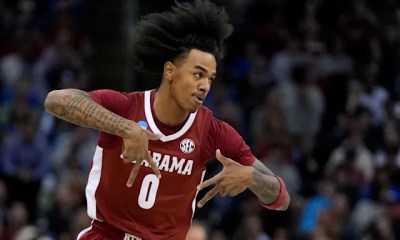
Bailey played one season at UCLA during the 2022–23 season, helping the Bruins reach the Sweet 16 before declaring for the NBA draft. He was selected in the second round and spent time on a two-way contract, appearing in a handful of NBA games while also logging extended minutes in the G League over the next two seasons.
Now 21, Bailey is seeking to use what would be his final year of eligibility within the NCAA’s five-year window. His argument is rooted in fairness and consistency — that his brief NBA appearances and relatively modest professional earnings should not permanently bar him from competing in college basketball, especially as NIL compensation continues to blur the lines between amateur and professional status.
The NCAA, however, has maintained a hard stance: signing an NBA contract closes the door.
That dispute will likely be decided in court. But whether Bailey should be eligible and whether he would matter on the court are two entirely different discussions.
Revisiting Bailey’s College Role
At UCLA, Bailey was never positioned as a centerpiece. He was only a freshman as a top 10 high school recruitin his only college season joined a veteran-heavy roster with clearly defined roles, where structure and defense were prioritized over individual freedom. His responsibilities were narrow and controlled, designed to complement rather than dominate.
He functioned primarily as:
- A secondary ball-handler
- A downhill attacker in space
- A perimeter defender tasked with pressure rather than playmaking
There were flashes — moments where his athleticism and confidence showed — but his overall profile was that of a developing a 6-4 guard still learning how to consistently impact games on both ends. The tools were evident. The polish was not.
The NBA saw enough between his flashes and recruiting pedigree to draft him 41st in the 2nd round by the Minnesota Timberwolves to invest in his upside, betting that development would come with time and repetition.
Why This Isn’t a Simple “Pro Back to College” Story
There’s a tendency to assume that any player with NBA or G League experience would instantly dominate at the college level. History suggests otherwise. Development isn’t linear, and professional experience doesn’t always translate cleanly back down the ladder.
Bailey isn’t a cautionary tale or a sure thing. He’s a test case — not just for NCAA eligibility rules, but for how we evaluate players who take an early professional detour and then reconsider their path.
Before debating fairness, lawsuits, or precedent, there’s a more basic assessment that has to happen.
What does his game look like now — and how would it function in a college setting?
That’s the part of the story that actually determines whether this experiment would succeed.
A Snapshot of the Production: College, NBA, and the G League
Before projecting anything forward, it’s worth grounding this discussion in what Amari Bailey has actually produced at each level. The volume, efficiency, and role context change dramatically from college to the pros, and those differences matter.
NCAA: UCLA (2022–23)
Games / Minutes
- 30 games, 28 starts
- 26.9 minutes per game
Per-Game Production
- 11.2 points
- 3.8 rebounds
- 2.2 assists
Efficiency
- FG%: 49.5%
- 3PT%: 38.9%
- FT%: 69.8%
- True Shooting %: 55.3%
Advanced Metrics
- PER: 16.4
- Usage Rate: 19.4%
Bailey operated as a complementary guard on a veteran UCLA team, producing solid efficiency on moderate usage without being a primary offensive driver.
NBA: Charlotte Hornets (2023–24)
Games / Minutes
- 10 games
- 6.5 minutes per game
Per-Game Production
- 2.3 points
- 0.9 rebounds
- 0.7 assists
Efficiency
- FG%: 33.3%
- 3PT%: 12.5%
- FT%: 85.7%
- True Shooting %: 42.5%
Advanced Metrics
- PER: 9.7
- Usage Rate: 21.1%
The NBA sample is extremely limited and situational, offering minimal insight beyond confirming that Bailey’s role was marginal and tightly constrained.
G League: Greensboro Swarm (2023–24)
Games / Minutes
- 36 games
- 30.9 minutes per game
Per-Game Production
- 18.8 points
- 4.8 rebounds
- 4.3 assists
Efficiency
- FG%: 45.2%
- 3PT%: 35.8%
- FT%: 70.5%
- True Shooting %: 51.6%
Advanced Metrics
- PER: 15.1
- Usage Rate: 29.8%
This season represents Bailey’s highest-usage environment, with clear offensive responsibility and extended minutes.
G League: Iowa / Lincoln (2024–25)
Games / Minutes
- 26 games
- 25.2 minutes per game
Per-Game Production
- 12.6 points
- 3.3 rebounds
- 4.6 assists
Efficiency
- FG%: 43.4%
- 3PT%: 32.5%
- FT%: 71.4%
- True Shooting %: 51.8%
Advanced Metrics
- PER: 12.6
- Usage Rate: 24.0%
With reduced minutes and usage, both scoring volume and efficiency dipped compared to the prior G League season.
This is the full statistical baseline — college, NBA cameo, and two distinct G League seasons under different roles and workloads.
Now comes the harder part: translating what these numbers mean when projected back into a college environment, where spacing, pace, physicality, and role expectations shift again.
That’s where the real evaluation begins.
The Translation
Bailey’s baseline matters here. In his lone season at UCLA, he graded out as a 3.4 player on my scale. That’s the starting point — not a hypothetical, not a projection, but what he actually was in college.
From there, the question becomes how his professional experience translates back to the college game.
On my scale, NBA production is roughly 32% stronger than ACB-level college numbers, based on prior translation work. In theory, Bailey’s brief NBA stint would convert to roughly a 4.8-level college player. The problem is the sample. He appeared in just 10 NBA games, logging only 65 total minutes, almost entirely in garbage time. That’s not a meaningful developmental data set, and it’s not enough to confidently claim real improvement. A jump like that would be reasonable with a larger, more competitive sample — but that simply doesn’t exist here.
The far more reliable data comes from the G League, where Bailey logged two full seasons with real minutes and real usage. Historically, G League numbers translate at roughly 23% worse than ACB college production in this model.
Using Bailey’s best G League season (2023–24), the translation puts him at approximately a 3.9-level college player. That’s a modest improvement from where he was as a freshman, but not a dramatic one. His most recent G League season tells a different story. With reduced effectiveness and multiple team changes, that season translates closer to a 3.3 player, essentially flat — or slightly worse — than his UCLA baseline.
Taken together, the numbers suggest a fairly narrow range of outcomes.
At the absolute high end, assuming a normal age-based improvement curve through 21, Bailey might have a ceiling around a 5.0 in this system. Realistically, the data points far more strongly toward him being closer to a 4.0 player, which would place him roughly around the 75th-best player nationally.
That actually tracks logically. He was a 3.4 player three years ago. Minimal but real improvement since then would land him right in that range.
And that’s before factoring in context.
Bailey has essentially missed an entire competitive season. He would be dropping into a college environment midstream, with no preseason, no ramp-up, and no built-in role clarity. Given that his most recent G League season showed regression rather than growth, it’s not out of the question that he struggles just to maintain his freshman-level impact early on.
Conclusion: The Risk Nobody’s Talking About
From a financial standpoint, the motivation makes sense. Pocketing one or two million dollars for a short college stint, then attempting to re-enter the professional market — whether the G League or Europe — is likely more than Bailey will ever earn in a single season again.
From a basketball standpoint, though, the picture is less flattering.
The numbers don’t suggest a dominant college star. They suggest a second- or third-option on a good team, not someone who comes in and overwhelms high-major competition. And that creates real downside. If Bailey comes back and isn’t clearly very good — not just solid, but unmistakably impactful — it risks reinforcing doubts about his trajectory rather than changing perceptions.
That’s especially true given how difficult it has been for other players to jump into ongoing seasons and immediately perform, even without a year-long competitive absence.
There’s a version of this where Bailey returns, plays well, makes money, and buys himself another professional opportunity. There’s also a very real version where the move backfires — where the gap between expectation and reality becomes impossible to ignore.
The eligibility fight may be novel. The basketball risk is not.
And based on the numbers, it’s larger than most people want to admit. It’s sky falling in the doors it opens, but probably not in adding a player that kicks down championship odds.