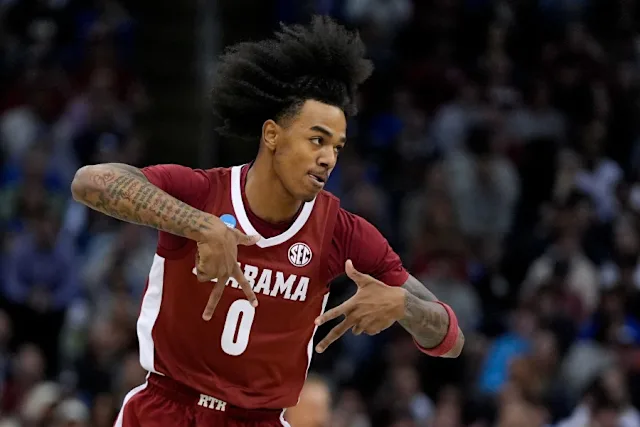
Editor’s Note: Shortly after this article was published, reports surfaced that Aden Holloway had been arrested on serious charges. It is currently unclear whether he will play in the NCAA Tournament or how significant a distraction the situation may become for Alabama. In the model used for this article, removing Holloway from Alabama’s top-six rotation would lower the Crimson Tide’s rating to 4.70 to roughly 8th overall. That still leaves Alabama as a competitive team by the numbers, but it introduces uncertainty and a potential cloud over the program that may not be fully captured in the analytics now regardless.
By the time the NCAA Division I Men’s Basketball Tournament begins, most analysis revolves around full-season metrics: efficiency margins, adjusted tempo, and deep rotation data. But tournament basketball often plays out differently.
Rotations tighten. Coaches cut the shit and lean heavily on their best players. Injuries also remove key contributors and shift the balance of power.
To explore that reality, I ran an experimental model that only evaluates each team’s top six players—while removing injured players likeJT Toppin, Caleb Wilson, Caleb Foster, and Richie Saunders.
The premise is simple: when the games matter most, depth matters less and star power matters more. Even coaches known for deeper rotations historically shorten them once the stakes rise. The way I see it some of those teams like Purdue that have been playing Cluff for example less theoretically have an extra gear now if they were to play him 10 more minutes in games.
The results were fascinating—and in some cases surprising even as someone that follows this closely. I’m just going to post the numbers as is. There is no coaching factor in these rankings, it’s strictly a top 6 team talent rating.
Rating
1
Alabama
5.18
2
Michigan
5.11
3
Arizona
5.00
4
Purdue
5.00
5
Duke
4.77
6
Arkansas
4.75
7
Illinois
4.72
8
Kansas
4.69
9
Vanderbilt
4.65
10
Florida
4.62
11
Wisconsin
4.37
12
Houston
4.31
13
Michigan State
4.28
14
UCLA
4.22
15
NC State
4.22
16
Kentucky
4.19
17
SMU
4.19
18
Iowa State
4.17
19
Tennessee
4.16
20
Connecticut
4.15
21
Louisville
4.11
22
Virginia
4.08
23
Ohio State
4.00
24
Texas
4.00
25
St. John’s
3.96
26
Georgia
3.95
27
Nebraska
3.92
28
Gonzaga
3.76
29
Villanova
3.75
30
Brigham Young
3.69
31
Missouri
3.66
32
Iowa
3.65
33
Miami
3.65
34
TCU
3.61
35
Clemson
3.60
36
Texas Tech
3.57
37
UCF
3.54
38
Texas A&M
3.44
39
North Carolina
3.35
40
Utah State
3.26
41
Santa Clara
3.25
42
St. Mary’s
3.10
43
VCU
2.68
44
Saint Louis
2.50
45
N. Iowa
2.26
46
McNeese St
1.86
47
Hofstra
1.48
48
Hawaii
1.38
49
Cal Baptist
1.28
50
Miami (OH)
1.17
The Model’s Top Contenders
Alabama – The Most Dangerous Roster
The biggest surprise in the numbers was Alabama Crimson Tide men’s basketball.
When evaluating only the top six players, Alabama came out with the strongest group in the entire tournament field.
The guard play is what really jumps out. My model traditionally favors teams with elite big men, which is where I believe most of the value is derived. However, Alabama’s two elite guards, combined with strong frontcourt production, give them an unusually balanced profile in the model. They have two point-of-attack creators and, in my view, two of the more underrated players in the country. That gives them something many teams simply don’t have at the same level. When the three-point shot is falling, they should be able to beat anyone with the highest ceiling, and Sherrell has emerged as an anchor in the post—previously their biggest question mark I had.
The concern is volatility. Alabama’s offense is heavily built around three-point shooting. In a single-elimination tournament, that kind of variance can either propel a team to big upsets and a title or eliminate them early. They just lost to an uninspiring Ole Miss team, which highlights that risk. That said, this is a full-season evaluation and not a reaction to recent form. I think that’s the correct way to view it. We just saw Purdue flip a switch late in the season, and there are plenty of examples in college basketball where talent eventually wins out in the tournament, and Villanova shot their way to a title before. The ceiling here is extremely high if Alabama is playing well. If things break right, the numbers suggest they are fully capable of winning it all.
Purdue’s Rising Stock
One team trending upward is Purdue Boilermakers men’s basketball.
The numbers suggest Purdue’s ceiling changed recently once Oscar Cluff —began playing heavier minutes. When that player is on the floor for 28+ minutes, the team’s interior dominance becomes far more difficult to handle in this recent streach.
Even before Purdue’s latest win was added to the data, the model placed them Tied for Third in the power rankings.
I don’t know why a player as good as Oscar Cluff was playing 19 minutes a game, but having him on the court 28 to 35 minutes is an extra gear not measured in the entire team season data that can be deployed in the tournament if Matt Painter will stick with it.
Michigan: Three Elite Bigs, One Huge Question
Few teams are as fascinating as Michigan Wolverines men’s basketball.
The gap between Michigan’s big men and guards is enormous and what happens when you get in a close game and have to have a bucket or steady up the ballhandling.
Even more complicated is the rotation math. With three elite bigs competing for minutes, you only have 80 post minutes to distribute. Figuring out how to maximize all three during high-pressure tournament games will determine whether Michigan reaches its ceiling.
I’ve always questioned whether you really want Yaxel guarding in the post, given his defensive numbers at UAB. If you move him to small forward that’s been help this year, as Michigan has done at times this season, it creates diminishing returns on offense—even if it helps hide some defensive issues. Those three have been on the court 533 possessions this season and the lineup has been a strong +39.9, but it’s the 9th most played 3 man group and there are better lineups statistically indicating diminishing returns on their talent. They are obviously picking their advantageous spots with it so what happens if they are battling in a tourny game are they really going to have the confidence to play it late in crunch time?
Where Alabama’s or Purdue’s roster fits together naturally, Michigan has real questions. How many minutes can you realistically get from the big three? During And if you play them all at the same time, what issues might that create in crunch time, when you typically want your best ball handlers and free-throw shooters on the floor? During the Purdue loss Yaxel went for 35 minutes, but Johnson only 24 and Mara 27. A close Wilson game before that they were able to get all three over 30, perhaps in a preview of how.
This is a high-floor team, but the fit limits the ceiling in my view. The biggest challenge is figuring out how to get all of these great players 30+ minutes per game every competitive game. It’s not as clean as teams like Purdue or Alabama, where you can easily get 35 minutes from your top players simply by putting them on the court although I don’t always trust coaches that have limited them in the past.
Teams the Model Is Skeptical Of
UConn
The recent two time defending champions, UConn Huskies men’s basketball, finished just 22nd in the top-six player power rankings. That’s because they only have 1 top 100 player in the model in Tarris Reed, and even he is only a 26 minute a game player as the 16th best player in the model. I guess there is some hope that he could play 35 and raise the ceiling some, but will Hurley ride him. He never had to a player like Clingan, or when they were deep, but this team really needs it.
That doesn’t necessarily mean they’re weak or can’t have success—it just suggests their value may be more dependent on depth and system execution, which this model intentionally discounts.
Houston
Similarly, Houston Cougars men’s basketball came in 12th.
Houston’s identity is built around defense and depth rather than star-level offensive production. In a tournament where stars often take over games, that profile carries some risk when the shots aren’t going in. Solid floor, but when they need offensive punch it could be an issue.
North Carolina
The injury to Caleb Wilson significantly hurt North Carolina Tar Heels men’s basketball.
Without him, the model ranks UNC just 39th in the tournament field, far below their typical national perception.
Miami (OH)
An undefeated regular season didn’t translate well analytically for Miami RedHawks men’s basketball.
The RedHawks rank 50th in this model, largely due to a weak strength of schedule. It’s a reminder that dominating lower-tier competition doesn’t always prepare teams for tournament-level opponents. The problem no one really addresses is if you are going to have a schedule like they played, at least destroy it if you are actually good. They won so many close games vs bad teams this year I have a hard time respecting the talent of the team. It just feels more like luck and the numbers suggest that.
Potential Upsets
A few teams stand out as upset candidates:
NC State
The model likes NC State Wolfpack men’s basketball with most of their value in their top 6 enough to project a Sweet 16 run, including a possible upset of Gonzaga Bulldogs men’s basketball.
UCLA over UConn
If healthy, UCLA Bruins men’s basketball projects as a statistical favorite over UConn in the second round. Health is the question
Missouri
Missouri Tigers men’s basketball was the only other double-digit seed the numbers suggested might actually be favored in a round one matchup in my model, though a potential meeting with Purdue could quickly end that run.
Best Mid-Major Teams
Outside the traditional power conferences, two programs stand out:
Santa Clara Broncos men’s basketball
Utah State Aggies men’s basketball
Both teams rank highly when evaluating their top six players and could outperform expectations if their stars deliver. Saint Louis came in lower than expected.
Final Four Prediction
Based strictly on the top-six player model and the brackets:
Final Four
Alabama
Duke
Illinois
Arizona/Purdue (it’s a tie, I’d personally pick Purdue)
Championship Game
Alabama vs. Arizona/Purdue
Champion Projection
Alabama
Do I think Alabama will win, no but this is what this simulation predicts and I can see how they would win. There is a high ceiling and a very battle tested team playing one of the top strenght of schedules. The fit and balance is nice as well to lean into.
Why This Model Is Different
Most predictive systems analyze entire rosters over a full season. This approach assumes something different:
Tournament rotations shrink
Stars play more minutes
Injuries matter more
Battle-tested production against strong schedules becomes critical
In other words, March basketball is not regular-season basketball where coaches dick around way to much. This is a power ranking on the teams that have the best per possession players for when coaches will play them more.
This is the first year testing this particular approach to power rankings, so its long-term predictive value is still unknown. For now, it should be viewed as experimental. That said, if even a few of these projections prove accurate, it may offer a clearer lens into what actually decides games in the tournament. The underlying rationale, however, I think is sound.
If the numbers hold, the team cutting down the nets may simply be the one with the best six players—a group that stays healthy, develops that stronger continuity over the course of the season hopefully for some, and possesses the necessary firepower and ceiling.
Somewhat surprisingly, Alabama emerges as that team in this iteration of the model. Make of that what you will.