With the turn of the calendar and the NCAA tournament commencing in just a couple of months, let’s delve into our All-Time college basketball coaching rankings. We will also explore which active coaches are poised for potential resume-building runs.
Adjusting For Pre-1985 NCAA Champions: Why We Need To
Years
Field
Rounds
1939-1950
8 Teams
3
1951-1975
22-25 Teams
4
1975-1985
32-53 Teams
5
1985-Present
64-68 Teams
6
It’s challenging to accord the same level of respect to NCAA Champions before 1975 as those after 1985. After 1985, teams had to win six games to secure the championship, and all the top teams were included in the tournament. In the years preceding 1975, there were instances where top five and top ten ranked teams were left out of the NCAA tournament. Marquette, for example, even chose to skip the NCAA tournament altogether in favor of participating in the NIT. By 1985, the tournament had evolved into the format we recognize today. These rankings will certainly be weighted to give greater emphasis to coaches who achieved most of their success in this era.
Rules Changes
In addition, the NCAA introduced a shot clock for the first time in 1985 and implemented the three-point shot in 1986, thereby solidifying the game in the modern era we recognize today. These changes occurred around the same time as the NCAA’s expansion to a full six rounds.
Achieving 7 Final Fours in 9 seasons, including 2 championships, after the expansion to 6 full rounds is a feat that may never be replicated. Even as a young observer at the time, it was evident that this coach was on the path to greatness, poised to eventually set the all-time win record and numerous other records. Surpassing 1200+ wins, participating in 100+ NCAA tournament games, and securing 13 Final Fours require a special coach. It takes a unique combination of skill and longevity to stay in college coaching for as many years as he did without succumbing to the allure of NBA opportunities. While the 5 championships appear the most breakable among his records, the challenge remains formidable.
Jim Calhoun
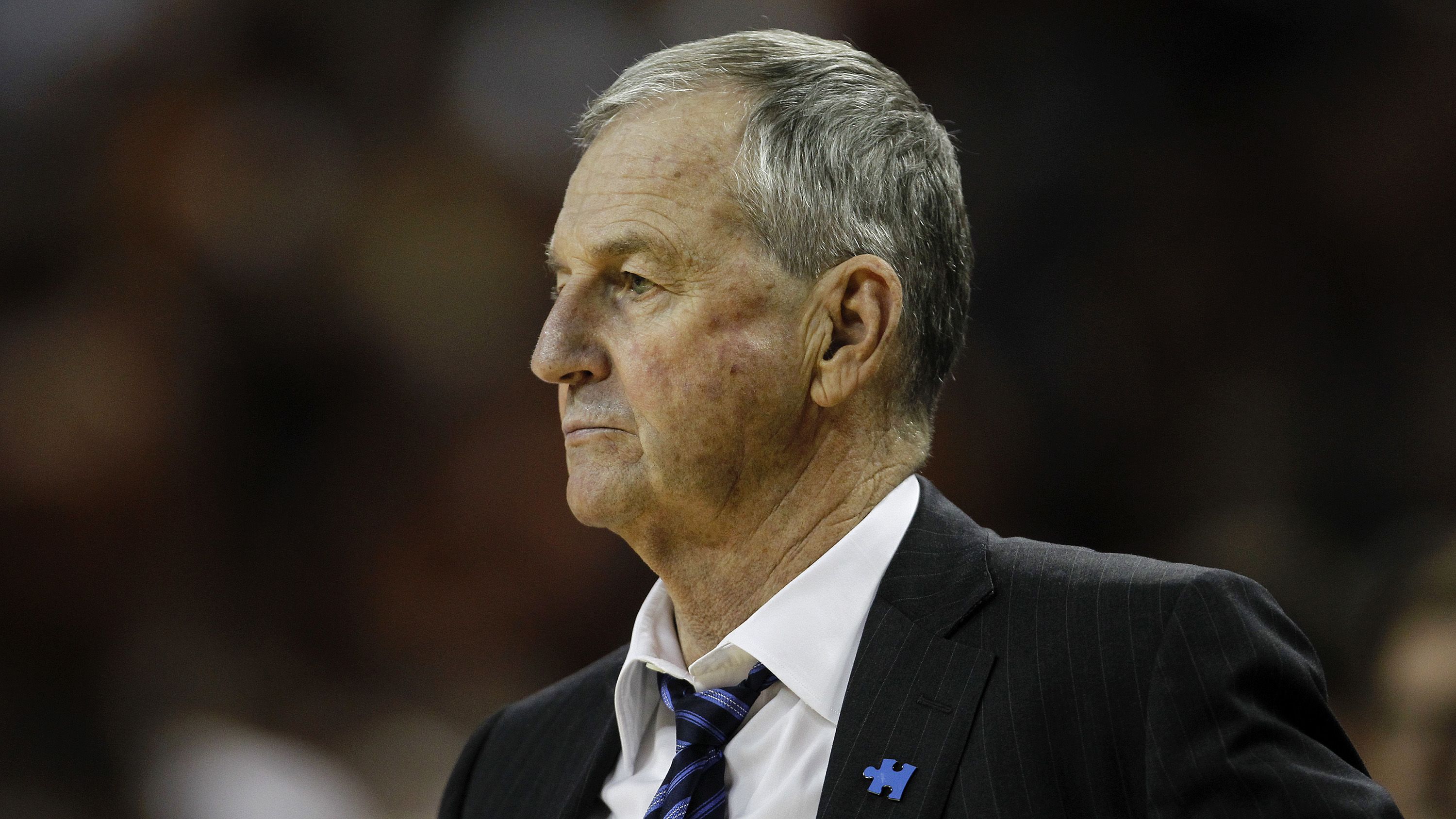
In our assessment, Jim Calhoun stands as the coach closest to challenging Coach K. Notably, he distinguishes himself by being one of the few top coaches who carved his own path, without a legendary mentor or emerging from established coaching trees.. Calhoun’s journey began at the high school level, and he elevated UConn, a program with minimal history, into a blueblood powerhouse, notably earning the most modern championships.
Unlike many elite coaches who were associated with blueblood programs that had already tasted championship success, or those from pre-1975 eras when college basketball lacked established powers and recruiting pipelines, Calhoun started from scratch. He meticulously built UConn into a formidable force, competing on par with traditional bluebloods, while some of his counterparts may have only resurrected existing success.
Taking over UConn, a program that had seen limited success prior to his arrival, Calhoun faced a unique challenge. The program had made only one Elite 8 appearance over two decades and had been absent from the NCAA Tournament for a decade. In contrast, other elite coaches often inherited programs with richer histories. Calhoun’s achievement of winning three National Championships, particularly in the 2000s and beyond, is undeniably impressive.
It’s worth acknowledging his role in the fourth championship that UConn secured two years after his departure, with key players he recruited and his hand-picked assistant and former player coaching. This underlines the lasting impact and legacy he left on the program. While you can’t give him credit for UConn’s most recent title he laid the foundation.
Roy Williams
Roy Williams’ resume is undeniably impressive, boasting nine Final Fours, three championships, 900 wins, and 79 tournament victories. However, when compared to coaches like Calhoun, there’s a notable distinction. Williams didn’t start at a school like Northeastern and build a powerhouse from scratch. Instead, he began his coaching career under Dean Smith’s guidance and secured the Kansas head coaching job as his first position before returning to UNC.
While Williams made the most of his opportunities and crafted an illustrious career, some argue that he was set up for success by stepping into prestigious coaching roles. The fact that he didn’t work his way up at a smaller program, such as Army, Northeastern, Tulsa, or Boston, raises questions about how his career might have unfolded in different circumstances. The suggestion is that other highly capable coaches could have achieved similar success had they been handed the keys to established powers and elite blueblood programs at the times Williams did. I
t’s a perspective that underscores the influence of the coaching environment on career trajectories and helping hands you can get. If he had started at mid major would he have ever done enough there to have gotten to a job like Kansas? We just don’t know that. Many of the other coaches on this list did have success at jobs like that or were the first to establish the school as a power.
Dean Smith
Dean Smith rightfully earns a place on our list as the first coach to emerge from the pre-shot clock NCAA expanded field era. Despite his roots in a different era, Smith demonstrated remarkable adaptability, leading his team to four Final Fours and securing a national championship well into the 1990s, post the mid-1980s expansion and significant rule changes. Even his famed “four corners” strategy, designed to control the clock, had its origins in the pre-shot clock era.
The majority of Smith’s success came after 1975, a period when rule changes ensured that most of the best teams were in contention, and the tournament field had expanded to five rounds. This timeframe adds to his credibility, and there’s a belief that had he continued coaching into the 2000s, his winning ways could have persisted. His lasting impact is further emphasized by the fact that his longtime assistant, Bill Guthridge, took over and led the team to two Final Fours in the three years following Smith’s retirement, with many of the players he had left behind.
Smith’s influence extended beyond his coaching achievements. Serving as a mentor to renowned coaches like Roy Williams and Larry Brown, he contributed to the development of coaching talent in the sport. Achieving 13 straight Sweet 16 appearances is a remarkable feat that would be challenging to duplicate in the modern era. Notably, nine of those years occurred after the expansion to 64 teams, and in only one of the other years did the team not win at least two NCAA tournament games. When Smith took over the UNC program, it had won a national title but wasn’t considered an established blueblood or power at the time, unlike programs such as Kansas, Kentucky, or Ohio State. Smith’s tenure saw him do the heavy lifting, and the bulk of his success occurred in the more modern era of college basketball.
John Wooden
Some may question how a coach with 10 national championships isn’t higher. I would liken it to the situation where no one considers Bill Russell the greatest player of all time, despite leading a team that secured 11 championships. The context matters; it was a distinct era. Just as the Celtics competed against, UCLA emerged from the comparatively weaker west, needing to win only 4 games to claim a championship for all but the last title under Wooden (5th round).
This aspect often proves challenging for most coaches, in my opinion, as they navigate the gauntlet of 6 wins in the tournament. Even if the first round is typically easier for the top 4 seeds, it introduces another stressful game, where upsets are not uncommon. Needing to win only four games for 9 of the titles, coupled with the absence of multiple other top 25 teams in the field every year, presents a significant advantage. Nonetheless, achieving 10 championships in 12 years is a formidable accomplishment in any era or circumstance and the teams he had were undisputed strong with some of the greatest college players ever like Lew Alcindor and Bill Walton. Further supporting his case is his triumph over coaching legends such as Dean Smith, Bob Knight, and Denny Crum (twice) in the NCAA Final Fours from 1968-1975. These coaches are also all time greats who had teams strong enough to challenge for the championships at the time. Denny Crum was from his coaching tree as well.
Bob Knight
Perhaps the most remarkable achievement is his attainment of three National titles and 900 victories coaching at the highest level, all while having only one NBA All-Star player throughout his career. While he coached numerous players who later joined the NBA, it is noteworthy that he succeeded without relying solely on elite talents in the same way most other coaches on this list did. The significant aspect lies in his ability to mold and lead teams to success that were more than the sum of their parts typically and pioneering the motion offense.
However, what places him behind Dean Smith in my perspective is the shift in performance as the NCAA field expanded and rules evolved. Unlike Smith, who continued to win both a championship and reach multiple Final Fours in the 1990s, there seems to be a decline in his coaching prowess during that period despite Smith being older and coming from a more distant era.
Bob Knight’s last championship came in 1987, a year after the introduction of the three-point line and two years post the implementation of the shot clock. By the 1990s, teams had learned to effectively utilize these changes, and Knight’s coaching style and influence seemed to wane. His last appearance in the Final Four was in 1992, with only one Sweet 16 appearance in the last 13 years of his coaching career. The shift towards a more modern game and changes in recruiting appeared to have surpassed his coaching strategies by that point.
It’s worth noting that despite these challenges, Knight’s left a team behind at Indiana, which his assistant successfully guided to the championship game. Despite lacking highly talented players, and a team with only NBA Journeyman Jared Jefferies. A hallmark of most Indiana teams.
Lute Olsen
Lute Olson, much like Jim Calhoun, stands out as one of the few coaches who did not emerge from an established coaching tree and the helping hands up that come with that. Olson carved his path through high school and junior college coaching before securing his first Division I job at Long Beach State. What distinguishes him is that the majority of his notable successes and Final Four appearances occurred in the modern era, following tournament expansion and rule changes.
His crowning achievement came in 1997 when he led Arizona to a championship, overcoming formidable opponents in Dean Smith and Rick Pitino-led teams. What makes Olson’s tenure truly remarkable is the transformation he brought to Arizona’s basketball program who had been in the WAC just prior to his arrival. Arizona had made only three NCAA appearances in their history, winning just one NCAA game. By the time he left, the Wildcats had secured four Final Four appearances and clinched one championship, establishing themselves as a formidable force in college basketball. Olson’s impact extended beyond victories, leaving an enduring legacy that solidified Arizona as a powerhouse in the basketball landscape. We reward him more for doing it at a place it had never been done, and in the era he did it.
Rick Pitino
Rick Pitino, now at his 7th NCAA school, has been a coach whose success has accompanied him throughout his career, albeit not without recent controversies. His ability to drop into schools like Boston or Iona and compete at a high level is a testament to his coaching prowess. Despite the vacated championship at Louisville and his departure under challenging circumstances, Pitino is on a redemption path. His coaching legacy already stands as all-time great, featuring 7 Final Fours at three different schools and 2 championships.
Pitino undertook significant rebuilding efforts at both Kentucky and Louisville, which had faced difficulties before his arrival. Leaving Kentucky in a strong position, he handed off a team that Tubby Smith led to a championship with many of Pitino’s recruited players. His impact on the programs he’s been a part of is evident in their sustained success.
Now at St. John’s, Pitino has an opportunity to add another chapter to his storied career in the twilight. The outcome remains to be seen, but his track record suggests that he has the potential to make a meaningful impact and continue shaping the college basketball landscape and was a mentor to another coach on this list in Billy Donovan.
Billy Donovan
The achievement of back-to-back championships has occurred seven times in total, but only twice in the modern era. Evaluating this accomplishment prompts consideration from two perspectives: did Billy Donovan seize a unique opportunity with a specific group of players, or does winning two championships with distinct teams showcase more depth and versatility? Both viewpoints have their merits.
While winning back-to-back championships is undeniably notable, it requires maintaining a cohesive and focused group over an extended period. Donovan’s ability to keep his team together and grounded during their hunted status is commendable, especially given the rarity of such occurrences.
The choice to value winning championships with two different teams reflects versatility and adaptability. In Donovan’s case, achieving success at Florida, a program with limited NCAA tournament history prior to his arrival, adds another layer of accomplishment. Florida’s relative underdog status compared to perennial powerhouses like Kansas or Kentucky amplifies the significance of Donovan’s achievements.
Furthermore, Donovan’s commitment to running a clean program distinguishes him in an environment where ethical concerns have arisen for other coaches on the list. Although his coaching career was voluntarily cut short by a move to the NBA, there’s speculation that he could make a return to college for one last hurrah. If he does, it wouldn’t be surprising to witness Donovan pursuing further success and potentially climbing higher in coaching accolades.
Bill Self
Bill Self still has the opportunity to make a case for a spot among the top 3 coaches. His journey, winning over multiple programs while working his way up the coaching ladder, is noteworthy. The achievement of taking a program like Tulsa to the Elite 8 is viewed by some as more impressive than guiding Kansas to the Final Four. We tend to think it’s one of the more impressive aspects of his resume.
Self’s early tenure at Kansas did see a few losses in the tournament, but he has evolved into what many consider the best coach in college basketball today. However, akin to Pitino, questions surrounding NCAA violations have followed Self, adding a layer of complexity to his coaching legacy. As he continues his career, Self has the potential to further solidify his position among the coaching greats and perhaps even climb higher in the rankings before he is finished.
Tom Izzo/Jay Wright
Ranking Jay Wright and Tom Izzo presents a challenge, given the varied nature of their accomplishments, despite coaching similar durations and taking over established programs where they were previously assistants.
The crucial distinction lies in the perspective one adopts regarding championships versus Final Fours, tournament wins, and appearances. Izzo boasts the longest streak of NCAA appearances in history, a testament to sustained excellence. On the other hand, Jay Wright’s coaching tenure at Villanova saw a group of players secure two championships in three years, a remarkable achievement.
While it’s a close call, we tend to lean towards Izzo’s impressive record of 8 Final Fours and more than double the number of NCAA tournament wins. This consistent success, coupled with the extended NCAA appearance streak, adds weight to Izzo’s coaching legacy. However, both coaches have left an indelible mark on their respective programs and the broader landscape of college basketball.
John Calipari
John Calipari’s achievements at both UMass and Memphis are undeniably remarkable. The success he orchestrated at these institutions, particularly considering the challenges and contexts, stands out. It’s noteworthy that if the Final Fours hadn’t been vacated, he might have been positioned much higher on the list, potentially just behind Bob Knight.
Building a formidable program at Memphis, especially during a period when they competed in a comparatively weaker Conference USA, is a significant accomplishment and with the championship at Kentucky he’s a made man.
Denny Crum
Denny Crum stands out as one of the more underrated coaches in our opinion, possibly overshadowed by the ending of his coaching career, which culminated in a 12-19 season in CUSA, leading to his departure due to job performance concerns. One of the only elite coaches to end this way. While the concluding season may have left a lasting memory, it’s essential to acknowledge his overall contributions.
The success did experience a decline in the late 1990s, yet Crum showcased some resilience by leading his team to an Elite 8 in 1997 and three other Sweet 16 appearances from 1993-1996 while coaching in far lesser conferences by that point in the Metro and CUSA. We believe he adeptly adapted his coaching strategies probably better than most of his peers. He had more success later than Bob Knight for example.
Crum’s coaching prowess is evident in his two championships, secured in 1980 and 1986. The 1986 victory occurred after the field expanded to 64 teams and the shot clock was added,, and even the 1980 triumph was notable as the tournament required 5 wins to clinch the championship, unlike the earlier pre-1975 format. It was also still a more legit title.
It’s worth noting that Crum inherited a program that was already in good standing when he took over. Louisville had reached the Final 4 and achieved top 10 finishes before his arrival, indicating that he built upon an already solid foundation that maybe you don’t think would be the case for a program spending time in lesser conferences.
Jim Boeheim
Longevity undoubtedly holds significance, and Jim Boeheim’s remarkable career in basketball at Syracuse spans an impressive 60 years since he first set foot on Syracuse’s campus, with an astounding 47 years as the head coach. His achievement of being the second individual to surpass 1000 wins invites two perspectives. On one hand, it is a credit to his enduring presence and influence on the game. On the other hand, some might view it as relatively modest to have secured only 5 Final Fours and one championship over such an extended coaching tenure.
Boeheim’s career presents a unique and intriguing narrative, with the added complexity of his departure from coaching towards the end. Evaluating his legacy becomes a nuanced task, considering the blend of longevity, notable successes, and the challenges he faced. His 47-year coaching span is a testament to his enduring impact on Syracuse’s basketball program, making his career a formidable and challenging one to replicate.
Adolph Rupp
Adolph Rupp emerges as one of the more controversial figures on this list rank, a sentiment reflected not only in his relatively low ranking but also in part due to the principles his Kentucky team represented at the time. While he secured four national titles, it’s crucial to note that three of them were attained before 1951, with the last in 1958. The context of his coaching career becomes significant, particularly with his last Final Four appearance in 1966, marked by the notable loss of his all-white team to Texas Western, who fielded an all-black lineup.
Understanding the era in which Rupp competed is essential. Pre-1966, when self limitations were imposed on many of the best players, and coaches often adhered to restrictive racial quotas, it becomes challenging to fully appreciate the competition. Rupp, unfortunately, becomes entwined with a period where he was part of the problem and contributed to perpetuating issues related to race in basketball by working for Kentucky. It was said he wanted to recruit black players.
Post the 1958 title, Rupp’s coaching accomplishments lack depth. Continuing until 1972, with the 1966 Final Four being the sole notable finish, his later years were marked by several poor seasons. This period coincided with a rapid evolution in basketball, both in terms of racial composition, skill advancement, and increasing popularity. Rupp seemed to be left behind, unable to adapt to the changing landscape, and failed to achieve the success in an era where only four wins were required for title contention.
We can’t put him on the same level as others prior, and I think you could make the case to have ranked even lower behind many of the modern coaches with only 1 win. His biggest accomplishment probably is that he established Kentucky as a blue blood program even if it was a more wide open time, and the longevity where he kept it strong building the foundation. There was a points shaving scandal that nearly derailed it and with a death penalty he navigated through.
Active Coaches Not Ranked
These are the top active coaches are not ranked in our top 75, but are coaches that could get into the conversation if they were to have a deep run.