Building on an article from 2 years ago on the relevance of JUCO recruiting the landscape has shifted even further in the NIL era—not just for JUCO, but with Division II emerging as a legitimate parallel pipeline into Division I in a way it wasn’t 5 years ago.
In 2023, there were 80 players who transferred from Division II to Division I. That number rose significantly in 2024, climbing to 132—and the pipeline has remained strong in 2025. 15 D2 All American’s transferring up in the last two years.
Looking at this year’s returns, one thing stands out immediately: it’s getting harder to find true high-end impact players from either level.
A couple years ago, you could reasonably expect to pull multiple top-50 caliber players from these pools, especially JUCO like Chad Baker-Mazara, Yaxel Lendeborg, or Oscar Cluff . D2 had Bennett Stirtz who while not as high in our rankings still a top 100 player at worst. That no longer appears to be the case.
Instead, what we’re seeing mostly is a flattening of outcomes which will help us project next years class upside.
At the top end, JUCO still offers upside that’s difficult to replicate elsewhere.
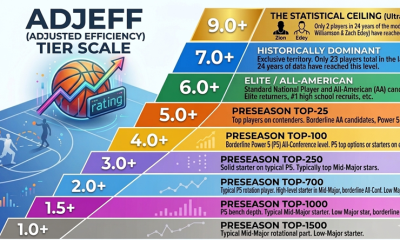
Xavier Edmonds (5.07 ADJeff, TCU) looks like a true difference-maker
Vaughn Weems (3.30) and Isaac Garrett (2.56) provide solid returns
That said, once you move past the top tier, the drop-off is steep—and familiar.
There’s a long tail of players:
Struggling to scale production
Landing closer to replacement-level impact
Or simply not translating at all
Even among players with strong JUCO résumés (20+ PPG scorers, high usage), the hit rate remains inconsistent.
That’s the tradeoff with JUCO:
You can still find elite players
But you’re also taking on significantly more risk
The variability is real, and it shows up quickly once these players are placed into structured, higher-efficiency systems.
D2: Lower Ceiling, Higher Floor
Division II transfers, on the other hand, are carving out a different identity.
The top-end returns are strong—but not quite at the same ceiling as JUCO:
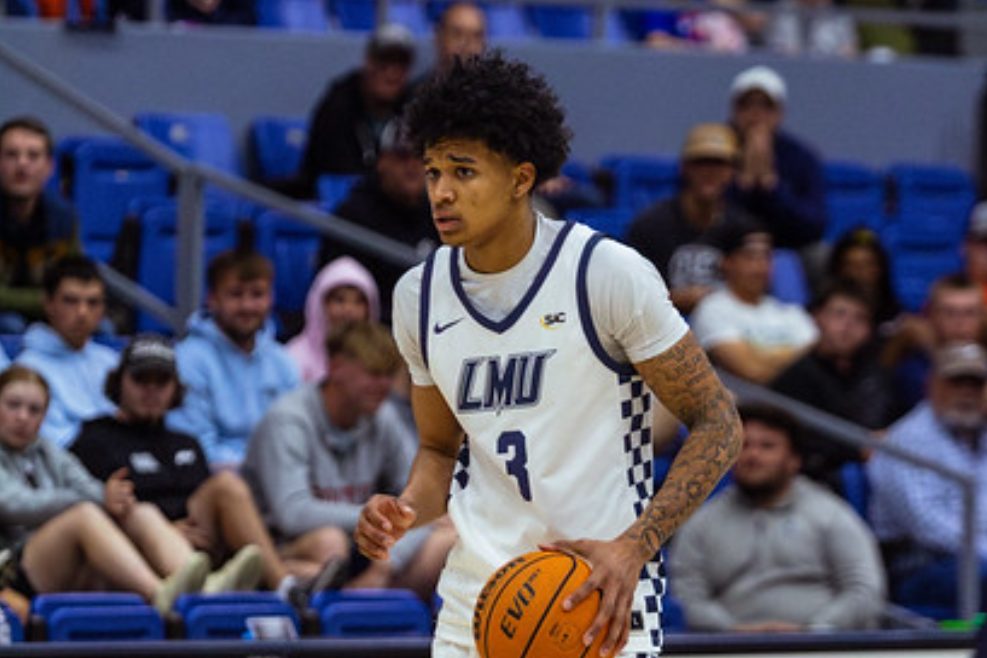
Elyjah Freeman (4.26, Auburn) is a major hit
Alex Steen (3.63, Florida State) and Caleb Van De Griend (2.40) follow
But the real story is in the middle.
Compared to JUCO, the D2 group shows:
More consistency across the board
Fewer complete misses
More players settling into functional D1 roles
You’re seeing fewer extreme outcomes—both good and bad.
A large portion of this group falls into that 1.0–2.0 ADJeff range, which typically translates to:
Rotation players
Low-to-mid major contributors
Depth pieces that don’t hurt you
And in today’s portal-heavy roster building environment, that has real value.
Why the Gap Exists
The differences between the two pipelines are starting to make more sense when you zoom out:
JUCO
Younger rosters
More projection involved
Less structural consistency
Greater talent variance
D2
Older, more physically mature players
More system-based basketball
Often competing against experienced 4th/5th-year players
Production that translates more cleanly
Lower typical upside
In short, JUCO is still a bet on talent—D2 is betting on reliability.
The New Reality
The biggest takeaway from this cycle:
Neither JUCO nor D2 is consistently producing as many high-end D1 stars anymore.
Instead:
JUCO gives you a shot at a home run—but with real bust potential
D2 gives you a much safer single or double—but rarely a home run
And across both groups, the days of mining multiple top-50 level players in a single cycle appear to be fading.
Roster Construction Implications
For staff building rosters in 2026, this creates a clearer strategic split: Both levels are pretty much regulated to the mid and low major D1, while P5’s take their players from lower level D1’s. For Mid and low majors.
Need upside? JUCO still offers that swing—but you better be right
Need stability and depth as a lower level D1? D2 is increasingly the safer bet
The optimal approach may not be choosing one over the other—but understanding the role each pipeline plays.
Because in the current era, it’s no longer about where the player comes from.
It’s about how much risk you’re willing to take to find impact. I think both typically exceed greater outcomes still for high school recruiting for mid and lower level mid majors. I wouldn’t be dropping big NIL money on either level.