College basketball hype can be a funny thing. Some players get carried by glowing media narratives, transfer portal buzz, or historic program prestige, while the numbers tell a different story. This list isn’t meant to take shots at the players themselves — most are extremely talented and even the worst still rank in the 92nd to as high as 99th percentile in my model — but to highlight how groupthink and inflated expectations can create a gap between perception and actual statistical performance. In other words, this is more about the hype machine, but we have to use examples. These are players whose rankings I’ve seen that are vastly different from what my statistical model projects. Maybe some of them can reach the levels the industry predicts, but in my opinion, they are basing them without the actual evidence to back it up so well just present our perspective as a counterpoint. Let’s take a look.
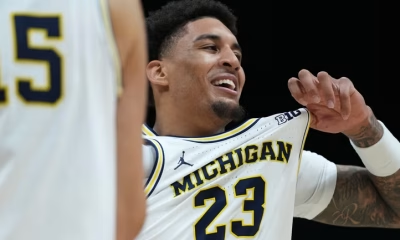
Yaxel Lendeborg – Michigan
Yaxel Lendeborg enters the season with sky-high national hype, yet his production raises serious questions when adjusted for competition. Some outlets rank him as high as No. 2 nationally, while my model places him at No. 63 — a sharp contrast that highlights how inflated his reputation has become. Much of his performance came against one of the weakest schedules in Division I, a 351st-ranked nonconference slate and the 11th-best AAC. Even against that soft competition and the 140th SOS overall, he failed to crack a 30 PER. By comparison, Zion Williamson posted a 40+ PER against a top-10 schedule.
Defensively, Lendeborg anchored a 231st-ranked unit while logging 34 minutes per game, following a 198th-ranked defense the previous season. Yet industry people project him to be the Big Ten “Defensive Player of the Year” under these circumstances, which is questionable. He even had another big beside him at UAB, and the defense was atrocious. Statistically, other post players posted comparable or superior per-100 stats against far tougher competition. Lendeborg is talented, and Michigan’s system should highlight his passing while masking defensive weaknesses, but the idea that he is a top-five national player doesn’t hold up when accounting for context and strength of schedule. This comes after my model had him 49th last year, higher than anyone, but now people are over their skis based on the actual resume.
Here are Lendeborg’s (and Folgueiras) apples to apples per 100 possession numbers in comparison to some other bigs in another ranking.

Bennett Stirtz – Iowa
Bennett Stirtz’s perception as a top-tier, top-five national talent does not survive closer scrutiny. While his raw numbers are impressive, context matters: he averaged 39 minutes per game against the 170th-ranked defensive schedule — one of the weakest in the nation. Adjusted models that factor per-possession stats, strength of schedule, and minutes place him No. 95 nationally statistically, far below the No. 3 ranking given by some human-based media outlets.
Stirtz’s MVC system is highly controlled, and he is only two years removed from second-team All-Conference Division II honors, a pedigree that rarely translates directly to top-five national projections. While he has upside based on the system he is in, I think he is more a product of the system. If he played for Jeff Capel or Bobby Hurley, would anyone have him here? The narrative placing him among the nation’s elite is inconsistent with objective metrics and the quality of competition he has faced, but Ben McCullom is an impressive coach, so I don’t completely shut the door on it. Still, it’s way too high given the information today.
Tayton Conerway – Indiana
Conerway posted strong raw numbers last season, but context exposes limitations in his projection to a Power Five conference. His efficiency — .540 true shooting — came against one of the weakest schedules in Division I, ranked around 200th nationally. Much of his scoring came at the rim against subpar competition, and he struggles with outside shooting and free-throw reliability, shooting under 30% from three and 66% from the line. A high usage rate further inflates turnovers and limits overall efficiency.
Comparisons to players who can draw fouls, hit free throws, and generate offense efficiently against top-35 competition highlight the gap when you are doing it versus a 200th-ranked schedule. Despite a great PER, Conerway’s assist-to-turnover ratio is modest, and his scoring profile is unlikely to translate at the rim the same against stronger, disciplined defenses. Teams can also foul him and send him to the line, where he’s more of a liability than a positive. Media narratives placing him in the top 45 nationally overlook the stats and competition, and my model ranks him No. 424 — a massive gulf between perception and production.
Tucker DeVries – Indiana
DeVries has garnered attention largely from a small sample — eight games versus weak nonconference opponents — inflating perceptions of his ability. Some outlets have him ranked as high as No. 23 nationally, while my model places him at No. 128, reflecting the gap between production and reputation. His successes have been closely tied to some likely unsustainable .473 outside shooting in the eight games, where no one talks about him also being 30% from two-point range and facing lower-level competition in his last full season. Like Conerway, DeVries exemplifies how media narratives and portal hype can outpace actual performance against meaningful competition. He’s a good player, but likely not close to a top-25 one, at least based on anything he has done to this point.
Alvaro Folgueiras – Iowa
Alvaro Folgueiras is often listed as a top-100 player nationally, as high as No. 71 in one computer ranking, but my model slots him at No. 580, suggesting that ranking may be wildly inflated. Much of his statistical success came against one of the weakest schedules in Division I — the 341st-ranked defensive SOS — where dominance is expected. Even high PER numbers are context-dependent; performance against weaker teams doesn’t automatically translate to success in Power Five leagues like the Big Ten. His international play, shooting just 23%, raises additional concerns about consistency and efficiency outside favorable circumstances. While he will benefit from Ben McCollum’s disciplined system, methodically managed per-possession metrics adjusted for competition show Folgueiras as another player whose reputation outpaces the evidence. Versus a schedule that weak, if he were truly that level of player, you would have expected him to lead the nation in PER like Oscar Cluff did against much better competition.
Christian Anderson – Texas Tech
Christian Anderson’s reputation exceeds his measurable impact. Despite being ranked as high as No. 42 by some outlets, my model puts him at No. 150, a reminder that volume doesn’t always equal value. Just because you are slated to get a lot more of it doesn’t mean you can do more with it. In fact, the idea that he didn’t with less, and less pressure, would suggest otherwise. In 35 games for Texas Tech last season, he averaged 30.6 minutes per game with 10.6 points, 3.0 rebounds, and 2.2 assists. Efficiency metrics were underwhelming, yielding a PER of 14.9. Despite a 16.7% usage rate, he barely outproduces teammates per 100 possessions, indicating his numbers are more a product of a specific role, and now you will be asking him to be a second banana driving the team. Coupled with a moderate supporting cast, Anderson will need to carry a lot, offering little evidence he can independently elevate a team.
Xzayvier Brown – Oklahoma
Xzayvier Brown has drawn top-100 hype from some evaluators, yet my model ranks him at No. 361, a far more cautious assessment of his true value. Last season, he averaged 17.6 points, 5.2 rebounds, and 4.3 assists over 32 games, posting a 0.566 true shooting percentage and a PER of 19.2. While respectable, much of this production came against a weaker schedule ranked 143rd, diminishing the impact of counting stats. His shooting splits demonstrate competence but not dominance. Brown’s numbers are solid for mid-major competition, but when adjusted for strength of schedule and team context, they don’t support top-100 hype.
Jaland Lowe – Kentucky
Jaland Lowe’s reputation is inflated relative to his production. Some outlets rate him as high as No. 33 nationally, while my model ranks him at No. 151, suggesting projection is outweighing performance. Last season, he played 32.4 minutes per game, posting a subpar .499 true shooting percentage against the 64th-ranked SOS. His low volume and inefficient scoring make it unrealistic to expect him to replace elite production, such as what Butler previously provided. Even within a strong Kentucky system, Lowe’s limited scoring efficiency combined with high-level competition suggests he is overvalued as a primary or secondary offensive option. Turning him into a “star” would require a level of efficiency he has yet to demonstrate.
Kam Williams – Kentucky
Kam Williams’ hype far exceeds his production and skill set. Ranked as one of the top transfers and even in some mock drafts by certain services, my model places him at No. 818, highlighting a substantial gap between perception and measurable impact. He averaged just 9 points per game in 33 minutes in the AAC, with minimal contributions in dribbling, creation, or rebounding, totaling just 4.5 rebounds and 1.3 assists on the 144th-ranked team. Video analysis shows a low, awkward three-point release and limited fluidity, making him more of a mid-major rim-scorer than a versatile wing. In the 2025 free-transfer era, relying on a player like Williams as a long-term contributor is risky. His ranking appears driven more by system context and program affiliation than measurable impact, making him a prime example of a transfer whose reputation exceeds his demonstrated ability.
Jackson Shelstad – Oregon
Jackson Shelstad put up respectable numbers last season — 13.7 points, 2.9 rebounds, and 2.7 assists per game — with efficient shooting splits and a true shooting percentage of .57, but not close to star-level, yielding a PER of 15.8. While some outlets rank him as high as No. 32, my model places him at No. 104, reflecting a significant difference between projected impact and actual performance. Shelstad is a reliable rotation player, and any hype projecting him as a primary impact option overstates his influence.
Pop Isaacs – Texas A&M
Pop Isaacs is a high-volume, high-risk scorer. Over eight games last season, he averaged 16.3 points, 4.8 rebounds, and 3.9 assists, but this was a small sample. His previous year, which I think should also be considered, reveals him more as a “chucker” rather than a well-rounded offensive option. While some outlets rank him No. 90, my model places him at No. 251, illustrating a significant difference between perceived versus actual value.
Donovan Dent – UCLA
Donovan Dent stands out as an efficient, high-value guard. Last season, he averaged 20.4 points, 2.3 rebounds, and 6.4 assists over 35 games, with a PER of 22.6. Some outlets rank him No. 8, while my model places him at No. 57, a gap that suggests he may be overhyped relative to other elite guards. This is all against competition ranked 73rd best in the nation. I’m not going to rule out that he can be a top-25 player, but the numbers just weren’t at that level last year to place him there at this point.
Milos Uzan – Houston
Milos Uzan offers balanced, efficient production. Over 40 games, he averaged 11.4 points, 3.1 rebounds, and 4.3 assists, with a PER of 17.3 in 32 minutes per game. While some outlets rank him No. 13, my model places him at No. 49, reflecting a notable difference between hype and measured contribution. Like with many Houston guards, the system and bigs do the heavy lifting, and usually the volume-chucker guards get the glory for all the winning. Uzan isn’t as bad as some of the past ones like Caleb Mills, but I don’t think he’s actually the player driving the winning in the numbers that the hype suggests.
PJ Haggerty – Kansas State
PJ Haggerty has been widely hyped, but his numbers suggest some overvaluation. Last season, he averaged 21.7 points, 5.8 rebounds, and 3.7 assists over 35 games, with a PER of 22.2. Some outlets rank him as high as No. 7 nationally, while my model places him at No. 56, highlighting a substantial difference between perception and measurable impact. Much of his production came against weaker competition. High usage inflates stats relative to elite competition, and while his new coaching situation may help, the surrounding talent may not elevate his performance substantially.
Tayon Grant-Foster – Gonzaga
Grant-Foster is another example of overrated hype. Even accounting for injury, his production was below expectations, as it was in his previous fully healthy years. Last year, the bottom fell out with 14.8 points, 5.9 rebounds, and 2.1 assists on just 39.9% shooting, with a PER of 19.7 versus the 232nd-ranked schedule. My model ranks him No. 388 nationally, while some outlets still have him at No. 81, a clear gap that suggests narrative and past potential have inflated his reputation relative to context-adjusted performance. Even if he returns to form from two years ago, he’s still not close to a top-80 player.
Magoon Gwath – San Diego State
Magoon Gwath is solid but overhyped. He is ranked in the 30s by some outlets, while my model places him at No. 178, indicating the discrepancy between perception and actual impact. At San Diego State, he averaged 8.5 points, 5.2 rebounds, and 0.7 assists while shooting 50.6% from the field, with a PER of 18.3. Though his numbers are respectable, especially against a stronger schedule, they don’t justify national hype as a truly elite contributor yet.
Wesley Yates – Washington
Wesley Yates’s production warrants caution. Last season at USC, he averaged 14.1 points, 2.9 rebounds, and 1.8 assists, with a PER of 16.8. Some outlets rank him No. 52 nationally, while my model places him at No. 129, emphasizing a sizable difference between hype and measured contribution. While his scoring is efficient, the team’s poor defensive rating and system context suggest his overall impact may be overstated. His offensive rating raises further questions, indicating that while he can score, his contributions to team success may not match the hype.
Jeremy Fears – Michigan State
In his sophomore season, Jeremy Fears averaged 7.2 points, 2.1 rebounds, and 5.4 assists per game over 36 games, showing flashes of playmaking ability but continuing to struggle with efficiency and outside shooting, taking only one three-pointer per game as a small point guard. Some outlets rate him No. 33 nationally, whereas my model places him at No. 175, reflecting a significant gap between projected status and statistical impact. Not reflected in statistics is just how hard it is to build around a small point guard who doesn’t even take threes and has almost no offense, with a .52 true shooting percentage. He’s a steady presence at point guard but far from a breakout performer — more of a facilitator than a star, and a player whose production didn’t quite live up to the hype surrounding him.
Karter Knox – Arkansas
Karter Knox averaged 8.3 points, 3.3 rebounds, and 1.0 assist per game over 36 games in his freshman season at Arkansas, showing flashes of scoring ability but limited overall impact. Some outlets rank him No. 88, while my model places him at No. 212, highlighting the gap between projected talent and current production. His PER of 13.6 and 2.5 Win Shares point to a player still finding his footing — productive in moments but not yet a consistent threat. Knox’s talent and physical tools are clear, but his first season suggested more promise than polish, with his game still developing beyond scoring in rhythm.



College Basketball
ADJeff College Basketball Player Ratings: OOC Wrap & Christmas Check-In

College Basketball
2025–26 Mid-Major College Basketball Rankings: Top 25 Non-P5 Teams

College Basketball
NCAA College Basketball (CBB) Top 25 Power Rankings

College Football
QB Transfer Portal Rankings 2025: Adjusted for Strength of Schedule
College Basketball
NCAA College Basketball (CBB) Top 25 Power Rankings

College Basketball
Who to Watch: 2025 D2 to D1 Transfer Rankings

College Basketball
2026 College Basketball Mock Coaching Carousel: Our Predictions

College Basketball
College Basketball’s Deepest Sleepers: Bet These Teams Early

College Basketball
2025–26 Mid-Major College Basketball Rankings: Top 25 Non-P5 Teams


College Basketball
Summer Clearance: Bargain Bin Shopping in the Portal


College Basketball
The Top 300 Returning Players

College Basketball
Top 200 transfers by Adjusted Efficiency