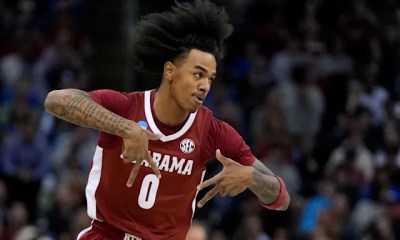
There’s a massive disconnect right now between what’s actually happening on the court at Kansas and the story being told about them nationally. And it’s not subtle. It’s not debatable. It’s one of the clearest cases in recent memory of a dominant, season-shaping player being functionally invisible to the people paid to explain the sport.
Flory Bidunga is not a role player. He is not a complementary piece. He is not a vibes guy, a culture guy, or a “does things that don’t show up in the box score” guy.
He is the clear reason Kansas is winning.
And the national media — the pods, the recap culture, the surface-level analysis — has completely whiffed on it.
A Week Before Arizona: The Signs Were Already There
This didn’t come out of nowhere. A week before Kansas knocked off the #1 team in the country, the underlying numbers were already screaming what was coming.
Kansas wasn’t just good — it was dangerous, and not in the way people expected.
At the core:
- Flory Bidunga playing at a top-five national level
- Tre White grading as an elite secondary piece
- Darryn Petterson, when healthy, a legitimate top-three player nationally on a per-possession basis
Even without Petterson fully available, the math was uncomfortable for anyone paying attention. Kansas had a top-end talent profile that very few teams could match:
Two players arguably in the top five if Petterson was healthy, and a third in the top 40.
That’s not depth. That’s tournament structure.
March is not about your ninth man. It’s about whether your top five or six can overwhelm opponents when rotations shorten and you play your best most of the game. Kansas already fit that blueprint — largely because Bidunga was anchoring everything that mattered. Petterson, if healthy enough to play, didn’t even need to be fully healthy. Even at the level he was playing while hurt, he still graded out top five and only elevated things further.
And yet, the national framing was so predictable that I intentionally listened to national podcasts just to see what narrative they would offer to explain why Kansas was playing so well with Petterson missing 11 of the 24 games.
The Arizona Game: Exhibit A
Kansas beats the #1 team in the country.
Arizona shoots better from three — which has been the story of the year given Kansas’s lack of perimeter shooting.
Kansas is missing Petterson.
And still wins.
Why?
Because Flory Bidunga didn’t just play well — he broke the game.
The box score leaves no room for interpretation:
- 23 points on 8-of-11 shooting (73% from the field)
- 7-of-9 at the line
- 10 rebounds (6 offensive)
- 3 blocks
- Elite rim deterrence that never fully shows up in the stats
His advanced line is even more damning:
- 75.3% true shooting
- 158 offensive rating
- 19.2 BPM (best on either team)
- 6.3% block rate anchoring the defense
Kansas scored 107.9 points per 100 possessions in a game where it shot just 44.2% eFG as a team. Arizona actually won the perimeter math.
Kansas won anyway because Bidunga dominated the interior on both ends.
This wasn’t a “good big-man night.” This was a best-player-on-the-floor performance against the #1 team in the country — a team powered in the post.
And yet, nationally, the conversation drifted.
We heard about:
- McDowell stepping up
- Tiller making shots
- Tre White’s four points somehow being framed as a meaningful contribution and “big free throws”
- The building winning it
- The vibes
They even said the rim seemed to have a lid on it for Arizona over the final six minutes thanks to the Fog Allen gods. So Bidunga’s rim protection had nothing to do with that? Not a single mention.
What we didn’t hear — until a late, almost accidental reference to a single block — was the obvious truth. In fact, one member said that if it wasn’t in Allen Fieldhouse, Buries would have scored it. The lack of respect was stunning.
Flory Bidunga was the reason Kansas won, and it was obvious in real time. Yet the biggest national podcast, backed by a multibillion-dollar conglomerate, barely mentioned him at all — not as the driver, not as the anchor, not as the story.
He was barely referenced, except in passing, as getting a block that “would’ve been a layup in any other building.”
That’s not a miss. That’s malpractice.
The Guard Bias Problem
This isn’t new, but it’s getting worse. In fact, I tuned in expecting it — and they delivered even more than I anticipated.
The national media loves guards. Specifically:
- High-usage shot creators
- Guys who take 20+ shots
- Players who look like they’re “carrying” the offense
Efficiency and context get buried in the narrative.
So when a guard goes 6-for-25, plays 40 minutes, and ends up with 23 points, the story becomes leadership, toughness, and “this is his team.” One even called it the “Council Era,” literally labeling it “Council’s team.”
Yeah — the guy with a .487% true shooting percentage on the season who needed 25 shots to score 23 points. That’s pathetic on its face. He’s not terrible — he rates about 120th nationally in my model — but this framing is absurd.
Meanwhile, the big who scores 23 points on 8-of-11 shooting, controls the paint, erases mistakes with the second-highest block rate in the country, and literally swings the game defensively and offensively is treated like background furniture. Worse, McDowell and other role players got more praise in this podcast.
This is how narratives become completely detached from reality.
Kansas is not winning because of shot-creation variance.
Kansas is winning because Bidunga breaks the game defensively and finishes ruthlessly on offense.
What the Numbers Actually Say
Strip away the noise and the story becomes unavoidable.
Bidunga now grades as the #2 player in the nation in my model.
He is second only to Cam Boozer.
Kansas has played the 3rd-best strength of schedule in the country, and he has put up this profile against it — including elite interior defenses and rotations. Arizona brings Awaka off the bench, one of the best rebounders in college basketball history.
This isn’t dominance built on cupcakes. It’s sustained, scalable impact against elite competition.
Bidunga is the anchor of a top-10 KenPom defense. That matters — a lot.
Kansas doesn’t win because it outscores teams from the perimeter. It wins because opponents are forced into worse shots, fewer rim attempts, and bad decisions when Bidunga is on the floor.
Historically, this kind of season lives in rare air.
Bidunga isn’t having a “nice year.”
He’s having a Player-of-the-Year-level season by every meaningful statistical standard — efficiency, defense, rebounding, and impact against elite competition — if not for Boozer having the sixth-best statistical season (adjusted for SOS) in my database dating back to 2003.
And yet, Bidunga isn’t even part of the KenPom Player of the Year conversation, let alone the top 10.
From a stat-based perspective, that’s indefensible.
The Season Profile They Keep Ignoring
If the national media wanted an easy way to understand what’s happening, the season-long profile is sitting right there.
Flory Bidunga — 2025–26
- 14.9 points per game
- 9.0 rebounds per game
- 1.7 assists per game
- 2.8 blocks per game (2nd NCAA)
- 69.0% true shooting
- 27.7 PER
- 4.6 Win Shares in just 24 games
This is not empty efficiency.
This is elite-volume finishing, elite defensive impact, and elite rebounding — all against the 3rd-best strength of schedule in the country.
Bidunga isn’t padding stats against overmatched frontcourts. He’s doing this while anchoring a top-10 KenPom defense, absorbing the most physically demanding matchups every night, and still maintaining near-historic efficiency.
Put simply: this is what a Player of the Year résumé looks like.
And yet, he’s not treated like one.
What Happens If You Remove Him
Here’s the simplest test — the one national voices never seem to apply.
Take Bidunga off this roster.
Kansas is not a top-10 team. They may not even be a top-35 team right now given how much time Petterson has missed.
Now take out a high-usage guard shooting .487% true shooting.
Kansas still functions. You can find someone else on the bench to jack up 25 shots and make six of them. That’s doable — and hardly impressive.
That’s the difference between visible usage and actual value.
Bidunga isn’t flashy. He’s foundational.
And foundational players are the ones lazy analysis misses first.
This Is How Titles Are Won
Kansas right now resembles the best versions of teams that win in March:
- Elite interior defense
- Rebounding control
- High-end talent concentrated at the top
- Less reliance on bench depth
This isn’t accidental.
It’s being driven by a big man who dictates the geometry of the game.
Calling this anyone else’s team — or pretending it’s powered by inefficient shot volume — is an insult to basic basketball understanding.
Final Thought: The Easiest Moment, Still Missed
After beating the #1 team in the country, this was the easiest possible moment for the national media to correct course and give Bidunga his due.
Did they?
They didn’t have to understand the season-long metrics. They didn’t have to dig into adjusted ratings.
All they had to say was:
“Flory Bidunga was incredible, and he’s the reason Kansas won this game against Arizona.”
They couldn’t even manage that — or even include him in the “players who stepped up” segment alongside Jamari McDowell.
That’s why this matters.
Not because of Kansas. Not because of fandom.
But because when the most dominant player in a marquee game can still be ignored, it exposes how shallow the national conversation has become.
Flory Bidunga isn’t a secret.
The national media just isn’t paying attention — or doesn’t understand what it’s watching.
It was especially ironic that, after that level of analysis, the same podcast immediately pivoted to ripping a few AP voters for ranked Georgia over Miami (Ohio) in the AP Top 25, even though Miami (Ohio) sits 50th in NET, 83rd on KenPom, and 312th in strength of schedule while Georgia is top-35 in both major metrics — a disagreement that is at least defensible — yet somehow watching a dominant interior performance decide a marquee win over the #1 team in the country was treated as not worth mentioning; that contrast perfectly captures the problem with the current ecosystem, which rewards lazy surface level narratives.