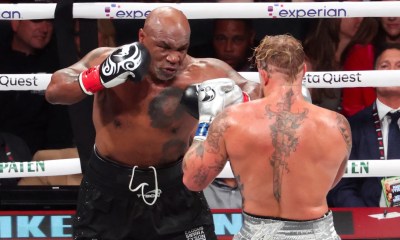
Two years ago, in August 2023, Jake Paul was fighting at 185 pounds. That fact alone is why I can’t take most of the reaction to this fight seriously.
On Saturday night, Paul stepped into a ring with a 6-foot-6, 245-pound heavyweight, a two-time former champion, an Olympic gold medalist, and—whether people like it or not—still one of the five to ten best heavyweights in the world. A fighter who has been doing this at the highest level for two decades.
That gap is the entire story.
Paul has 13 professional fights. His opponent has an entire boxing lifetime: Olympic dominance, championship rounds, heavyweight wars. Fighters don’t make that kind of jump. Not directly. Almost ever. Even all-time greats who moved up in weight—Roy Jones Jr. included—picked their spots carefully. They didn’t walk straight into the ring with a 6-6 245-pound heavyweight built to erase mistakes.
And yet, Paul did.
The strategy was obvious because it had to be. Paul circled, ran when he needed to, limited exchanges, and hoped to time something when Joshua stepped in. That wasn’t cowardice—it was survival. It was literally the only way this fight could exist past the opening rounds.
What surprised me wasn’t the approach. It was how long it worked.
Paul lasted six real rounds. He landed 9 of 22 power punches, absorbed shots that would have folded plenty of professional heavyweights, and stayed upright far longer than I—or most people—expected. Joshua clearly respected Paul’s power enough not to recklessly chase him down, which turned the fight into an awkward, tense stalemate where neither man could fully open up without consequence.
Eventually, reality won. Paul gassed. His legs went. His jaw broke.
But he didn’t quit.
I’ve seen all the comments saying the fight was scripted or staged. That’s always the reaction when something doesn’t fit neatly into people’s mental model of what boxing should look like, or lets be real people hate on Paul. But anyone who’s actually watched real fights—or understands what heavyweight punches do—knows how quickly that theory falls apart.
Fighters don’t script broken jaws. They don’t choreograph exhaustion. And they don’t fake the kind of cumulative damage that leaves someone unable to chew food by the sixth round. I think it’s pretty clear they were both throwing shots with intention to knock each other out.
In a sport where an average of 13 fighters die every year worldwide, this wasn’t cosplay. Paul could have taken a dive long before things turned ugly. He didn’t. He stayed in there, took punishment, and accepted real risk—the kind fighters spend entire careers trying to avoid.
That’s the part people don’t want to acknowledge.
This was stupid. It was insane. It was smart financially and strategically. And it was brave—all at the same time.
Fighters don’t go from 185 pounds to fighting super heavyweights because the human body isn’t built for it. The force is different. The margins disappear. Paul was never supposed to survive six rounds against a heavyweight of this size and pedigree.
But he did.
And in the process, he showed something even his critics have to grapple with: his chin is better than advertised, his conditioning held longer than expected, and his power—while not elite—was real enough to earn respect from a world-class heavyweight.
You don’t have to like Jake Paul to admit that. I don’t but I came away more impressed by his skills and was already impressed by the balls.
This wasn’t scripted in my opinion. There were too many moments where things could have gone catastrophically wrong. Paul didn’t step into that ring without stakes—real ones. He risked permanent injury. He risked never being the same again, even death. It’s a real thing in boxing and for much smaller fighters than he fouth. Today, he’s probably eating through a straw.
Most fighters spend careers navigating danger carefully—choosing opponents, managing weight, climbing divisions inch by inch. Paul skipped the entire process and walked straight into the most unforgiving division in the sport against a man built to punish mistakes.
He didn’t win.
But from where I’m sitting, he proved something anyway. His chin, his fitness, and his power are better than I even thought.
And whether people want to admit it or not, Jake Paul earned respect the hard way—by surviving nearly the whole fight he had absolutely no business being in.