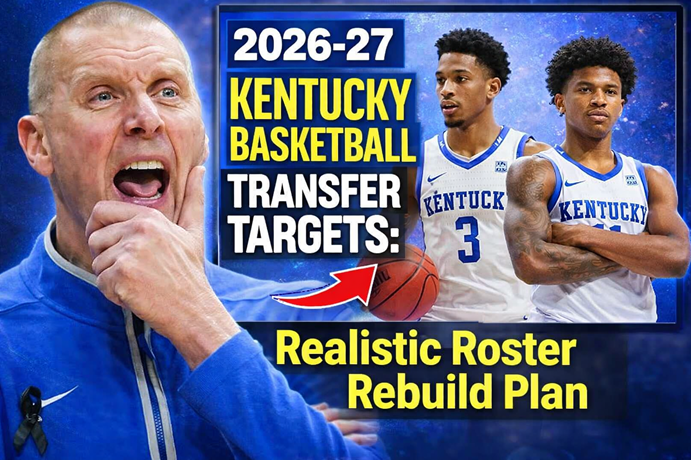
Kentucky is entering a familiar but newly complicated phase. The expectation remains championships, but the mechanisms for getting there have fundamentally changed. The Wildcats will almost certainly remain one of the richest programs in the sport, yet the era of simply buying everyone is likely over. Revenue sharing, roster salary caps, and a far more competitive NIL marketplace mean that efficiency now matters just as much as raw spending power. There might not be as much movement this offseason if the money is more evenly distributed through revenue sharing.
This isn’t about hoarding talent. It’s about building a functional roster — one that blends upside, experience, and cost control, while minimizing the annual reset that has quietly undermined continuity across college basketball.
What follows is not a fantasy list of the most expensive names in the portal. It’s a realistic rebuild rooted in three principles:
Retain a small, affordable core that already understands the system and what Pope wants.
Be willing to move on from solid-but-overpriced contributors.
Aggressively target high-utility portal players who outperform their resource level.
I’ve written extensively over the past few months about lower-resource Power Five teams, early mock portals, and overachieving mid-major rosters. This rebuild draws directly from that work. The goal is not perfection — it’s coherence.
The Current Roster: Who Fits the Next Version of Kentucky
Before discussing who Kentucky should add, it’s important to be honest about who actually fits where the program is headed.
The Core I’d Keep
Mouhamed Dioubate Dioubate is the easiest decision on the roster. He provides real basketball value — rebounding, defensive versatility, effort plays, and physicality. He scales up or down without breaking lineups or demanding high usage, which is exactly the kind of player Kentucky should prioritize in this era. He’s not a luxury item — he’s infrastructure to build around.
Malachi Moreno Moreno is young, affordable, and still very much on an upward development curve. At seven feet and 250 pounds, he gives Kentucky a true interior presence who doesn’t need touches to impact the game. Bigs like this take time. Kentucky can afford to let him grow — and should. As we saw last offseason, bigs are among the most sought-after positions, but I wouldn’t promise him anything other than a chance to compete for the job. He’s been good enough and is young enough that he might win it outright anyway. He’s probably a player Kentucky could retain for reasonable funds while also bringing in competition, maintaining some continuity.
These two form the backbone of what I’d consider a cost-efficient foundation.
Jayden Quaintance Quaintance is the biggest swing decision. He will likely explore the draft — and rightly so. If I were advising him, I wouldn’t have rushed him back even as soon as he did. If he returns, Kentucky benefits from rare athletic upside, and I think he would only get more healthy from this point forward. If he leaves, roster construction actually becomes cleaner than paying him while rehabbing his minutes and hoping he gets back. Either outcome is manageable — which is exactly how you want these decisions to feel.
Conditional Returns: No Promises, Just Opportunity
Jasper Johnson Johnson could return, but this has to be framed correctly. There are no guaranteed minutes. His value is developmental — youth, shooting potential, and local familiarity with the program. If he’s willing to compete without entitlement, there’s a role here. If not, Kentucky can’t afford to wait. He’s shown enough and is young enough that he should improve and has the pedigree to do so.
Collin Chandler A similar conversation applies. Chandler has tools and knows the system and that has value, but the next roster cannot be built on hypothetical upside alone. He can return, compete, and earn minutes as a shooter off the bench, possibly — but the bar needs to be clear from day one. He’s a role player, and if he doesn’t like that, moving on wouldn’t be the worst outcome either.
Willing to Move On: A Necessary Reset
This is the uncomfortable part, but it matters.
Players like Jaland Lowe, Kam Williams, and Brandon Garrison are not terrible players. That’s not the argument. The argument is value. At their likely NIL cost, they don’t provide the kind of surplus production Kentucky needs.
In a capped or semi-capped environment, good-but-expensive depth becomes a liability. Kentucky needs flexibility, not sunk costs. A partial reset here isn’t an indictment — it’s roster triage, and it’s how you rebuild by moving on and this is the area on the roster you correct.
The Portal Strategy: Attainable, Productive, and Role-Clear
Rather than chasing every five-star name or headline portal win, Kentucky should lean into what the data has been screaming for two years: experienced players from lower-resource or unstable environments who already produce against real competition and are being capped by role, minutes, or situation.
This isn’t about spending less. It’s about spending cleaner.
Kentucky will still be one of the richest programs in the sport. But the smart advantage isn’t outbidding everyone — it’s identifying players who are undervalued, miscast, or about to be squeezed, and then offering clarity where others can’t.
Fru checks multiple boxes at once: proven production, physical readiness, and a clear pathway to expanded minutes. And yes — a move that would absolutely irritate Louisville. That last part isn’t the reason you do it, but it’s not irrelevant either. Programs recruit against each other as much as they recruit for themselves. Fru is currently leading the nation in True Shooting yet is stuck in a sixth-man role, playing roughly 23 minutes per game. This isn’t a talent issue — it’s roster math, and it’s the kind of situation Kentucky could exploit if he’s unhappy with his current role.
Kentucky can credibly offer what Louisville can’t: a cleaner frontcourt depth chart with a path to 30 minutes, and a more focused NIL commitment directly tied to role. Fru has no ties as a German international — he’s already in the state. Commit early, promise real minutes, and let development play out. He’s already proven himself in Germany’s top professional league, where he averaged more points and rebounds than many 25+-year-old NCAA stars. For context, his production was roughly on par with Carsen Edwards in his basketball prime, showing that Fru can handle high-level competition. This is exactly the type of upside bet Kentucky should be making and paying up for.
Pettiford hasn’t been as dominant this season, but in the right situation, he’s shown what his ceiling can be. I predicted he would hit the portal in the preseason, and with the younger Pearl coming off the bench recently, it seems like he may feel the rug was pulled out from under him. He’s likely looking for a place where his role is defined and valued. Kentucky has history with Pettiford, having extended an offer when Calipari was still there, and another year in a structured, efficient role could help him far more than chasing volume elsewhere. He hasn’t yet made a real NBA impression, but in the right system, he could thrive.
Karasinski is the exact type of player Kentucky should be targeting. He already put up 24 points against Kentucky this season — it’s not theoretical, it happened — and his broader résumé backs it up with averages of 21 points and six rebounds per game against a top-85 out-of-conference schedule, including over half his games against Power Five, Mountain West, and American opponents. This isn’t a volume scorer padding numbers; it’s someone who has already proven he can function against higher-level athletes. Karasinski brings shot creation without ego, physical maturity, and immediate offensive competence. He doesn’t need developmental runway just to survive and could play right away, which matters more than chasing another theoretical ceiling. Add the in-state familiarity and experience, and Kentucky could potentially acquire him at a very reasonable price, giving him the opportunity to prove himself at a bigger stage.
Target: Devin Royal (Ohio State — Contingent on Coaching Change)
If Ohio State undergoes a coaching change, Devin Royal should be one of Kentucky’s first calls. Royal is an All-Big Ten-caliber player whose situation is far more volatile than his talent level suggests. Coaching uncertainty, roster turnover, and system fit all point toward a player who may be open to listening, especially if the pitch is honest. Royal brings size, versatility, and positional flexibility, and could play either forward position which Kentucky desperately needs to avoid lineup bottlenecks. His fit next to Dioubate isn’t perfect, but he is a high-level talent, and Kentucky has the resources to stack talent and let the best man win. He has improved his three-point shooting this year, which adds to his appeal, and in a stable system with a defined role, he could make an immediate impact.
Johnson is a 6-3 guard with scoring ability and upside, though there is some baggage. Still, he can deliver points and spacing in the backcourt. With a 2025–26 PER of 23.3, he is one of the best scorers in the nation if you’re purely evaluating talent. Kentucky could provide him with a stable role and clear expectations, allowing him to maximize his scoring and playmaking potential.
Kyle Jorgensen is one of the highest-rated transfers on the market and represents exactly the type of undervalued player my model flags early in January — historically, most of these early-season top 55 players actually move. The 6-9 Colorado State forward pairs perfectly with Carey Booth as a stretch-big combo, both capable of spacing the floor while also playing alongside other frontcourt pieces. Jorgensen’s 50% three-point shooting, 63.8% overall field-goal rate, and 27.3 PER show he can score efficiently both inside and out, making him an immediate fit in a versatile, high-upside Kentucky frontcourt perhaps and Andrew Carr type.
Brett Decker Jr. is a Kentucky native from Central Hardin who combines hometown appeal with elite shooting ability. The 6-3 Liberty guard is making an absurd 52.5% of his threes this season, averaging 4.1 made threes per game average 18.2 points he could be your Koby Brea type of player in the system.
Garland is a 6-1 guard with a knack for creating shots and hitting from distance. He has a 2025–26 PER of 23.2, averaging 20.1 points, 3.9 rebounds, and 4.2 assists per game, with shooting splits of 50.8% from the field, 35.6% from three, and 86.8% from the free-throw line. Garland is productive, versatile, and capable of stepping into a defined rotation role immediately, complementing the bigger pieces while providing perimeter scoring punch.
A Kentucky native, Moore could be tempted to come home and take a lower-cost roster spot while earning a clearly defined role. He has a 2025–26 PER of 25.4, averaging 18.2 points, 5.9 rebounds, and 2.7 assists per game, He has stepped up in big moments, including against top-10 Vanderbilt, showing he can rise to the occasion. A home-state discount, familiarity, and opportunity calling make Moore an attractive late roster spot option to stabilize the wing rotation.
A Realistic Blueprint: Building Kentucky Through Smart Transfers
This roster represents a mix of some of the highest-rated transfers on the market alongside players who are undervalued in my model. Last year, when I compiled a list of the top 55 likely transfers in early January, 47 actually ended up moving — so these projections are grounded in real trends. At the top, Sananda Fru anchors the frontcourt, complemented by Kyle Jorgensen, Jack Karasinski, Brett Decker, and Tahaad Pettiford, with Dior Johnson, Mouhamed Dioubate, Malachi Moreno, Collin Chandler, Jasper Johnson, and Teagan Moore rounding out the lineup. I think this is a reasonable build that Kentucky could realistically pay for and succeed in recruiting.
If additional resources were available, adding someone like Devin Royal could be tempting, though that may introduce too many mouths to feed in the rotation. This group fits the mold of what worked in year one under Pope’s system, with Jorgensen stepping into a Carr-type facilitator role, Decker filling a Brearley/Krisnki-Oweh-style wing spot, and Pettiford providing the scoring punch Butler did previously. Kentucky probably won’t find a passing big on the level of Amari Williams or what Pope had at BYU, unless Jorgensen’s 2.5 assists per game translate into meaningful playmaking on offense. Overall, this is my attempt at a realistic, well-fitting, and achievable transfer roster of players who might be motivated to move and contribute immediately.
Booth is a 6-10 forward with the size, skill, and versatility Kentucky covets for the frontcourt. He has a 2025–26 PER of 25.1, averaging 12.4 points and 7.1 rebounds per game, with shooting splits of 55.4% from the field and 45.7% from three. Booth combines inside-out scoring with rebounding instincts, and his efficiency shows he doesn’t need the ball to be effective. Kentucky could offer him a defined role alongside Dioubate and Moreno, development under a staff that maximizes his versatility, and a chance to compete for meaningful minutes immediately. He isn’t a flashy name, but he fits the productive, role-clear blueprint that has been a blueprint for Kentucky portal success.
Harris is a 6-7 forward who has quietly been excellent this year and could be attainable, especially if a coaching change shakes up Wake Forest. He has a 2025–26 PER of 21.9, averaging 19.4 points, 6.6 rebounds, and 1.6 assists per game. He has been consistently productive against Power Five competition, and Kentucky could slot him as a mid-rotation forward capable of scoring, rebounding, and defending immediately. Doesn’t shoot well enough however IMO for Pope on the wing.
Fielder is a 6-10 rim-stretching big who combines size with efficiency — exactly the type of forward Kentucky can plug into their frontcourt without worrying about rawness. He has a career 2025–26 PER of 34.2, averaging 23.1 points and 8.1 rebounds per game, with shooting splits of 58.1% from the field, 58.6% from three, and 82.2% from the free-throw line. He has shown he can perform on a big stage, dropping 42 points against Baylor, and doesn’t need a long developmental runway to contribute. In a stable system with a clearly defined role, Fielder could become a cornerstone forward immediately.