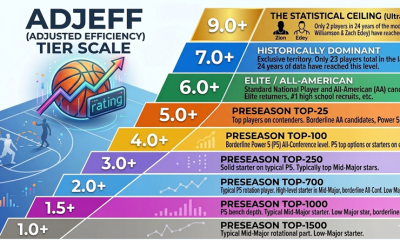
Every serious model needs a line — a threshold where production stops being “very good” that year and becomes historically elite.
In ADJeff, that line is 7.0.
Since 2003, only a small handful of players have crossed it. Not because the bar is arbitrary, but because the math is unforgiving. A 7.0 season represents a level of pace-adjusted, efficiency-weighted, competition-aware dominance that very few players ever reach.
This isn’t about style. It’s about value.
Why ADJeff Works Across Eras
This is the part that gets overlooked — and it’s the reason the model holds up. Even as rule changes, including the foul-charge interpretation, have ignited offense in recent seasons.
ADJeff is season-normalized.
That means:
Every season is graded against its own statistical environment
Scores are adjusted to that year’s overall distribution
There is no fixed historical baseline dragging values up or down
The model moves with the season, not against it.
What That Means in Practice Each Year
A 4.0 ADJeff means roughly the same thing every year
A 5.0 is consistently Top-25 caliber
A 6.0 is always elite
A 7.0 is historically dominant
Even as:
Pace increases or slows
Shot profiles change
Three-point volume explodes
Talent pools shift due to transfers and NIL
We saw this last year with players like Johni Broome, where competing in the toughest conference in the history of college basketball, by a lot during a final super-senior season — amid consolidated transfer talent driven by NIL — added a competition component that meaningfully matters. The ranges stay stable because the scale resets every season.
This is also why players from different eras can be compared. Even memorable high-minute counting stat stars like Trae Young, Kevin Durant, and Carmelo Anthony — who posted PERs of 28.3, 32.8, and 25.1, respectively — didn’t necessarily reach the same ADJeff heights. Durant, for example, didn’t face the same strength of schedule that today’s top players navigate. Modern leagues are stronger, and teams are more willing to play challenging out-of-conference schedules. To truly match the 7.0 Club level, Durant for example would need production and efficiency on par with Zion Williamson or Zach Edey while facing top 50+ strength of schedule competition in an era strength of schedule was weaker in to begin with.
That’s why you can legitimately compare players across eras — within the rules and norms of their time — without the numbers drifting or inflating over time.
The ADJeff 7.0 Club Since 2003
This is the short list — the most valuable individual seasons the model has identified.
That’s not the model chasing awards. That’s awards catching up to value.
Voters do seem to understand advanced stats better than they did a decade ago as well. It will be hard for a guard like Frank Mason (6.1 ADJeff) to win this award in the future I suspect. It’s already soon to be 8 years since we’ve seen one take it home. Voters are getting smarter about value.
The only players in the club who weren’t at least Consensus All-Americans — or came close — were John Collins and Daniel Oturu. Collins averaged 19.2 points, 9.8 rebounds, and 1.6 blocks in just 26 minutes per game while shooting an impressive 65.8% true shooting. Oturu, a 3rd-team All-American, averaged 20.1 points, 11.3 rebounds, and 2.5 blocks per game. Statistically, both had outstanding seasons and deserve recognition on any elite list, regardless of whether every voter acknowledged those years or not.
Why the List Is Big-Heavy
Yes — bigs dominate this list.
They always have dominated college basketball.
Elite college basketball is driven by players who:
Create high-efficiency shots at the rim
Control the defensive and offensive glass
Anchor team defense at the most important position
Force opponents to alter shot selection
There are only so many 18–23-year-old, 6’8”+ athletes on the planet capable of doing that at a high level. When a team has one, everything else scales upward.
Guards can absolutely matter — when they actually provide elite value:
High efficiency
Strong creation
Defensive impact
Low waste
But guards don’t get graded on a curve here.
This is not about aesthetics. It’s about math.
Basketball impact is a per possession game.
Final Thought
I don’t care why a player is dominant.
I care that they are — possession after possession, against real opponents, in the context of their season.
The ADJeff 7.0 Club exists to identify the rare seasons that break college basketball — regardless of era, pace, or style.
If a team wants to win, they should want players who land here.
Everything else is noise.
This year’s club will have its newest member, and with the remaining schedule and tournament, they could join the inner-circle elite of the club.