Back in September, I broke down how I would’ve allocated UNC’s reported $14 million roster budget differently. At the time, the takeaway was simple: the Tar Heels weren’t maximizing value in my estimation. Too many dollars were tied up in questionable fits, while better — and often cheaper — options were sitting there at reported similar prices or going to mid-majors.
Now that we have a full season of data, it’s worth revisiting those ideas — and how they ultimately contributed to the end of Hubert Davis’s tenure at North Carolina. This isn’t about a victory lap, but about evaluating what actually translated and where the biggest gaps showed up, particularly with several players who, in hindsight, looked clearly overrated in our preseason evaluation.
For the record, given the injuries, I thought Hubert deserved another year. But the decision has been made — and in my opinion, this is what ultimately decided it.The Hits That Held Up
To be fair, not everything missed. (National rank/ADJeff)
Caleb Wilson (No. 3 | 7.20) → Turned into a legit high-end player, far exceeding even the rosiest expectations. This is the kind of outcome that did cover up a lot of roster flaws — at least until he was injured.
Henri Veesaar (No. 27 | 5.85) → As expected, one of the best additions. Anchored the frontcourt and produced at a high level.
Seth Trimble (No. 216 | 3.88) → Solid, versatile, and about what you’d expect. Not a star, but not a problem either. Perhaps even slowed a bit by bad injury luck.
These were the backbone pieces — and they largely delivered. We expected Veesar and Trimble to be money well spent, and Wilson was much better than most thought he would even be.
Where It Fell Apart
The issue wasn’t the top. It was everything around it.
Jarin Stevenson (No. 335 | 3.28) → Fine, but not a difference-maker. More neutral than positive, but overall better than our model predicted. However the three point shot never came around or gave them much spacing.
Kyan Evans (No. 1683 | 1.13) → This was the biggest miss relative to cost as expected. Paying reportedly $2 million or more for that level of production is exactly what the preseason concern was.
Jaydon Young (No. 2655 | 0.43) → Even worse than expected. This was a low-efficiency player on a bad team, and it carried over.
Jonathan Powell (No. 964 | 1.80) → Slightly worse than expected, but at least made a respectable amount of three’s and was a threat.
This is where roster construction matters. You don’t need every player to hit — but you can’t miss this often in the middle of your rotation, especially with that kind of budget numbers.
The Alternatives: How They Actually PerformedThis is where it gets interesting. The players discussed as realistic alternatives didn’t just hold up — many clearly outperformed UNC’s choices.
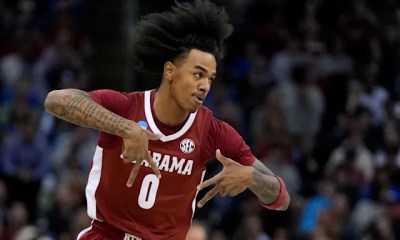
Ven-Allen Lubin (No. 32 | 5.74) → High-impact, all-conference level production. Not prioritizing him, keeping him engaged, and ultimately letting him walk looks even worse in hindsight. He would’ve been a natural fit next to Veesaar, who provides spacing, or backing him up at center. A clear upgrade over Jarin Stevenson. He also would’ve provided insulation for a Caleb Wilson injury. Stevenson still played 25.7 minutes per game, so the role was there — likely even bigger if UNC had committed to Lubin. This was really the original sin.
Chad Baker-Mazara (No. 68 | 5.03) → Exactly what UNC lacked: a dynamic, versatile wing who produces. This is the type of player you allocate a major pay slot to instead of missing on that value elsewhere.
PJ Haggerty (No. 115 | 4.57) → Massive upgrade at the guard spot compared to Evans, essentially in the same role and price range.
Jemel Jones (No. 565 | 2.55) → Outperformed both Powell and Young as a scoring option and would’ve added needed offensive punch to a team that finished 35th in offense.
Will Johnston (No. 1228 | 1.53) / Scotty Middleton (No. 1269 | 1.50) → Not stars, and they slightly underperformed our model expectations, but still comparable or better value at a likely lower cost — exactly the kind of efficiency plays that round out a winning roster. Still far better than the expected value of Evans at $2 million or Young, both of whom performed well below even those already modest expectations.
This wasn’t hindsight magic — these were realistic, attainable or should be attainable for a school like UNC or the caliber players discussed at the time in September. And across the board, they provided better return on investment.
The Bigger Point: Margin and Insulation
This is really what the preseason article was getting at — and what the season confirmed.
Roster construction isn’t just about your top-end talent. It’s about margin.
UNC hit big on Wilson. They got what they needed from Veesaar. That should have been enough to anchor a high-level team.
But the lack of value in the middle and bottom of the roster created zero margin for error.
No injury protection
No lineup flexibility
No secondary creators or scorers to stabilize things
So when adversity hit — whether it was injuries, inconsistency, or matchup issues — there was nothing to absorb it even with freshmen turning in better than expected outcomes.
What Could Have Been
Even a few of the suggested changes would’ve altered the trajectory:
Lubin + Veesaar → A proven, highly efficient frontcourt pairing
Haggerty over Evans → Immediate upgrade at a premium position
Baker-Mazara with Evans pay and push Trimble or Bogavac to PG→ More talent instead of a placeholder
Just another legit player likely gets them over the hump in several games they were playing Young or Evans especially, or Stevenson.
That’s the difference between a good roster and one that performs like a top-5 team relative to its budget.
Final Thought
UNC didn’t fail because of one particular move, but several in the roster construction and the allocation.
Spending $14 million should buy you margin. It should buy you depth. It should buy you the ability to survive the bad breaks they had better.
Instead, too much of that budget went to players who either didn’t fit, didn’t produce, or both.
And when that happens, even hitting on a player like Caleb Wilson isn’t enough to cover it up. Even prior to the injury their computer numbers were closer to late 20’s.