College basketball sleepers are far more fun to spotlight than the overhyped stars—you get to shine a light on players whose numbers scream potential, even if the headlines aren’t paying attention. This article celebrates players who are quietly outperforming expectations, posting strong metrics, and showing value that national rankings might be overlooking. From high-upside freshmen to transfers making efficient impacts, these are the guys who could surprise fans, shake up bracket predictions, or become breakout stars of the season. Consider this a national-stage shoutout to the underrated players who deserve more hype—and whose stats suggest they just might prove the doubters wrong.
These rankings include both human and computer polls released so far. There may be additional lists later in the season, which could bring in new names or adjustments—but for now, this article focuses on players consistently underappreciated across both ranking systems.
Some rankings are so far off that they aren’t worth including. Even in cases where one list seems credible, the other can be outright ridiculous. For example:
- Otega Oweh barely in the top 50 in a computer ranking.
- Chad Baker-Mazara not in a top 100 human rank.
- Jason Edwards nearly 300 in a computer poll.
- Nick Martinelli 200+ in a computer poll.
- Awaka 150+ in a human poll.
Often, either the human or computer rankings get it closer to what makes sense—but rarely both. In this article, we focus only on players undervalued by both systems, cutting out cases where just one ranking system misses the mark.
Transfers and Sleeper Standouts
KeShawn Murphy — Auburn
Let’s start with this since several of the names will appear.
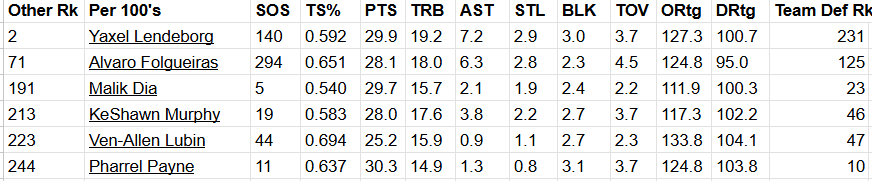
KeShawn Murphy might be the single most underrated player in college basketball, and the numbers back it up. My model ranks him No. 21 nationally, while a major human ranking barely had him in the top 100, and another computer formula placed him outside the top 210 — a massive disconnect.
At Mississippi State, Murphy quietly averaged:
- 11.7 points
- 7.4 rebounds
- 1.6 assists
- 1.1 blocks
…in just 24 minutes per game, posting an elite 24.8 PER (even higher in SEC play) and a 57.3 eFG%, despite operating in one of the nation’s worst perimeter offenses.
To put his production in context, consider Yaxel Lendeborg, a player some ranked top 2–3 nationally. On a per-100 possessions basis, Murphy’s numbers — 28.0 points, 17.6 rebounds, 3.8 assists, 2.2 steals, 2.7 blocks — mirror Lendeborg’s. Their true shooting rates (.583 vs .592) and usage (23.9 vs 23.4) are nearly identical. The difference? Lendeborg posted those stats against the 140th-ranked SOS, while Murphy did it against the 19th-ranked SOS, all in a broken offensive system with poor spacing.
In a year when all the top-tier strength was concentrated in the SEC, the top 35 teams faced strength of schedules as tough as the top 3 teams in most typical years. That can’t be understated—just how elite the top 40 SOS really were, even compared to what we’d consider a “normal” season. These teams were battling top competition nearly every night, which makes evaluating players and team performance even more fascinating.
Freed from Chris Jans’ system, Murphy looked poised to explode, though the retirement of Pearl at Auburn may impact him. Regardless, the analytics paint him as a top-25 player nationally, even if no one has noticed yet.
Pharrel Payne — Maryland
Pharrel Payne is the definition of a statistical monster hiding in plain sight. My model ranks him No. 28 nationally, yet he doesn’t appear in the top 150 of any major human ranking and sits 240+ in another computer model — a discrepancy so wide it’s almost laughable.
Despite limited minutes, Payne put up:
- 10.4 points
- 5.1 rebounds
- 64.6% FG
…against a top-10 SOS, all while averaging barely 20 minutes per game. His 25.1 PER and 64.6 eFG% show elite-level efficiency — numbers that would explode if a coach played him 30+ minutes.
It’s a prime example of groupthink dominating national rankings. Outlets that unanimously slot Naithan George in transfer rankings have ignored a 6’9”, 255-pound forward who destroyed high-major competition per possession. Payne’s omission from any list is egregious.
Nathan Bittle — Oregon
Not quite as misranked, Nathan Bittle has quietly put together one of the most efficient two-way seasons in the country. At 7’0”, he averaged:
- 14.2 points
- 7.6 rebounds
- 1.9 assists
…on 51.1% shooting, including 33.6% from three and 81.1% from the line. With a 25.5 PER, 56.1 eFG%, and nearly 5 win shares, Bittle’s production stacks up with any big in college basketball, all against the 18th best SOS and anchoring the 21st best defense.
My model ranks him No. 3 nationally, another computer formula has him 17th, one human list had him top 25, but another left him completely outside the top 100. Statistically, that’s indefensible. Bittle is clearly top-tier, combining elite efficiency and defensive impact, and could easily be an All-American with a stronger supporting cast.
If you want, I can take the next batch of players (Murphy, Payne, Bittle, and the international sleepers) and create the full “International Players & Sleepers” section next, keeping your tone, rankings, and stats-integrated style.
Nolan Winter — Wisconsin
Nolan Winter is one of those players whose efficiency metrics quietly outpace his box score perception. My model ranks him No. 31 nationally, compared to a human rank in the 100–150 range and a computer rank around 80. At first glance, that might seem generous for a guy averaging 9.4 points and 5.8 rebounds in 21 minutes per game. But dig deeper:
- 135 offensive rating
- 23.1 PER
- 64.0% eFG%
- 4.1 win shares
- 35.8% three-point shooting
…and low turnovers. Winter posted all this against a top-25 strength of schedule, showing elite efficiency for any rotation player, let alone a sophomore big on a balanced Wisconsin team. His numbers make him one of the most quietly valuable frontcourt players in the Big Ten and nationally.
Malik Dia — Ole Miss
Malik Dia is another under-the-radar impact player, the type whose advanced metrics scream “play me more.” My model ranks him No. 51 nationally, compared to 150+ in human rankings and 191 in another computer model.
Last season at Ole Miss, Dia averaged:
- 10.8 points
- 5.7 rebounds
- 46.7% FG, 34.5% from three
- 21.7 PER
…while playing a pivotal role on a team that finished 22nd nationally and improved defensively by over 100 spots, despite losing a former Big 12 Defensive Player of the Year and a 7-5 shotblocking leader now in the NBA.
Dia’s floor-spacing ability and defensive versatility make him a natural fit alongside Scott in the frontcourt. If Ole Miss unleashes him for heavier minutes, he’s not just a contributor — he’s a potential top-30 player nationally, hiding in plain sight behind underappreciated analytics.
Ven-Allen Lubin — NC State
Ven-Allen Lubin is one of those players whose numbers scream “All-Conference”, even if the narrative hasn’t caught up. My model ranks him as an elite forward, despite him being used as a role player for much of the season.
- 23.1 PER, 71% true shooting in ACC play
- Averaged 13.7 points, 7.2 rebounds, 2 stocks per game in just 24 minutes down the stretch
- Team went 8–3 in that span, including tough losses to Duke
- Posted the team’s best defensive rating despite smaller teammates
Lubin’s 7-foot wingspan, switchable defense, and elite finishing make him a modern forward who can carry efficient lineups without heavy touches. At 25 points per 100 possessions on nearly 70% true shooting, his per-possession production is almost identical to Yaxel Lendeborg but against incomparably tougher competition. If Will Wade gives him 25–30 minutes, Lubin could vault into All-ACC contention and force a reevaluation of why he wasn’t unleashed sooner.
Devin Royal — Ohio State
Devin Royal has quietly emerged as one of the Big Ten’s most efficient forwards. My model ranks him No. 25 nationally, yet most other services barely have him inside the top 100. Royal averaged:
- 13.7 points
- 6.9 rebounds
- 20.8 PER
- 52.5% shooting
…and did it against stiff competition, making him a quietly impactful player who deserves far more attention than he currently receives.
Top Internationals
When it comes to undervalued college basketball talent, several international players are flying completely under the radar. Based on first-year stat translations from professional leagues, it’s clear that Sananda Fru, Hannes Steinbach, Mario Saint-Supery, Thijs De Ridder, and Ruben Dominguez were all severely undervalued by both human rankings and traditional computer systems — if my translations are even close to accurate.
Discrepancies in Rankings
The differences are staggering:
- Sananda Fru: Translated stats suggest top-of-class potential, yet human rankings had him barely in the 100–150 range, and computers had him outside the top 500.
- Hannes Steinbach: Humans projected him 100–150, but computers placed him only barely in the top 350.
- Mario Saint-Supery: Playing in Spain’s ACB — the second-strongest league globally — posted a PER of 18 in just 15 minutes per game, yet human rankings placed him completely outside the top 150, and computers pegged him at 610.
- Thijs De Ridder and Ruben Dominguez suffered similar underestimation, with per-possession production far exceeding their given rankings.
First-Year Translations and Performance
This is my first attempt at translating international leagues into NCAA equivalents, and while there is some uncertainty, the numbers are compelling:
- Fru: Averaged 12.4 points with a 23.1 PER in Germany’s BBL, a league filled with prime-aged professional talent, including former NCAA stars and All-Conference veterans.
- Steinbach: Posted nearly identical PER in the same league, showing the strength and reliability of his production.
- Saint-Supery: In the ACB, he averaged 8.3 points and 2.1 assists in 14.7 minutes against elite competition outside the NBA — more impressive than many domestic prospects putting up volume in weaker leagues.
Spotlight on the BBL and ACB: Prime-Aged Talent and Undervalued Production
The German BBL (Basketball Bundesliga) and Spain’s ACB provide a striking context for evaluating international prospects, both leagues packed with experienced, prime-aged talent. Players like Sananda Fru and Hannes Steinbach are standout examples, yet they’ve been widely undervalued in human and computer rankings. To put it in perspective, Fru averaged 12.4 points per game with a 23.1 PER, while Steinbach posted nearly identical efficiency, all against seasoned, prime-aged competition.
Consider Carson Edwards, a 27-year-old former NCAA 24-ppg star, who averaged 14.9 points with a 16 PER in the BBL last year. Even compared to him, Fru and Steinbach’s efficiency is impressive. Other recognizable prime-aged professionals in the league include DJ Horne, Darrius McGhee, Tra Holder, Isaiah Cozart, Osun Osunniyi, Demajeo Wiggins, Chuba Ohams, and Malik Osborne — multiple players putting up 15/10-style production against high-level competition.
Meanwhile, the ACB is even more stacked, with teams featuring 6–7 former NBA players per roster, providing context for why Mario Saint-Supery’s efficiency (PER 18 in 15 minutes per game) is so meaningful. Production against that level of talent is far more impressive than comparable volume in weaker domestic leagues.
The takeaway is clear: both the BBL and ACB are full of All-Conference-caliber talent, yet many of their top performers like Fru, Steinbach, and Saint-Supery fly under the radar. Their translated stats suggest they could have immediate impact at the college level, and programs willing to invest in these undervalued players are likely to reap substantial rewards.
Even conservative translations suggest these international players outperform much of the domestic talent currently ranked ahead of them. Fru and Steinbach, in particular, emerge as “sleepers of all sleepers,” with efficiency and per-possession output capable of top-25-level contributions once given meaningful minutes.
The Takeaway
These international players are undervalued both statistically and perceptually. Traditional human rankings and computer models lag behind the data, but per-possession analysis and first-year translations highlight their upside. College programs that tap into talents like Fru, Steinbach, and Saint-Supery early are likely to reap immediate rewards, both on the stat sheet and in team success.
The Value of Looking Beyond the Rankings
College basketball is full of hidden talent, and both human and computer rankings frequently miss the players quietly reshaping the game. From domestic sleepers like KeShawn Murphy, Pharrel Payne, Nathan Bittle, Nolan Winter, Malik Dia, Ven-Allen Lubin, and Devin Royal, to international standouts like Sananda Fru, Hannes Steinbach, Mario Saint-Supery, Thijs De Ridder, and Ruben Dominguez, the numbers tell a story that often diverges sharply from the hype.
Advanced metrics, per-possession analysis, and first-year stat translations reveal players who are efficient, impactful, and ready to contribute at a high level, even if the mainstream media or traditional computer models haven’t taken notice. These are the athletes who can shift team dynamics, surprise fans, and make significant impacts in national rankings and tournament play.
The takeaway is simple: don’t rely solely on consensus rankings. By examining the underlying data, we can identify the sleepers — players whose production, efficiency, and potential put them in a tier that rankings haven’t yet recognized. For coaches, analysts, and fans alike, keeping an eye on these undervalued contributors may be the key to spotting the breakout stars of the season.



College Basketball
How They Fared: JUCO vs. D2 Transfers — Volatility vs. Stability


College Basketball
The Slow Death of the NIT

College Basketball
The Most Absurd High School Stat Line You’ll Ever See

College Basketball
NCAA College Basketball (CBB) Top 25 Power Rankings


College Basketball
2025–26 Mid-Major College Basketball Rankings: Top 25 Non-P5 Teams

College Basketball
2026-27 Kentucky Basketball Transfer Targets: Realistic Roster Rebuild Plan

College Basketball
2026 College Basketball Mock Coaching Carousel 2.0: Updated Predictions


College Basketball
Summer Clearance: Bargain Bin Shopping in the Portal


College Basketball
The Top 300 Returning Players

College Basketball
Top 200 transfers by Adjusted Efficiency