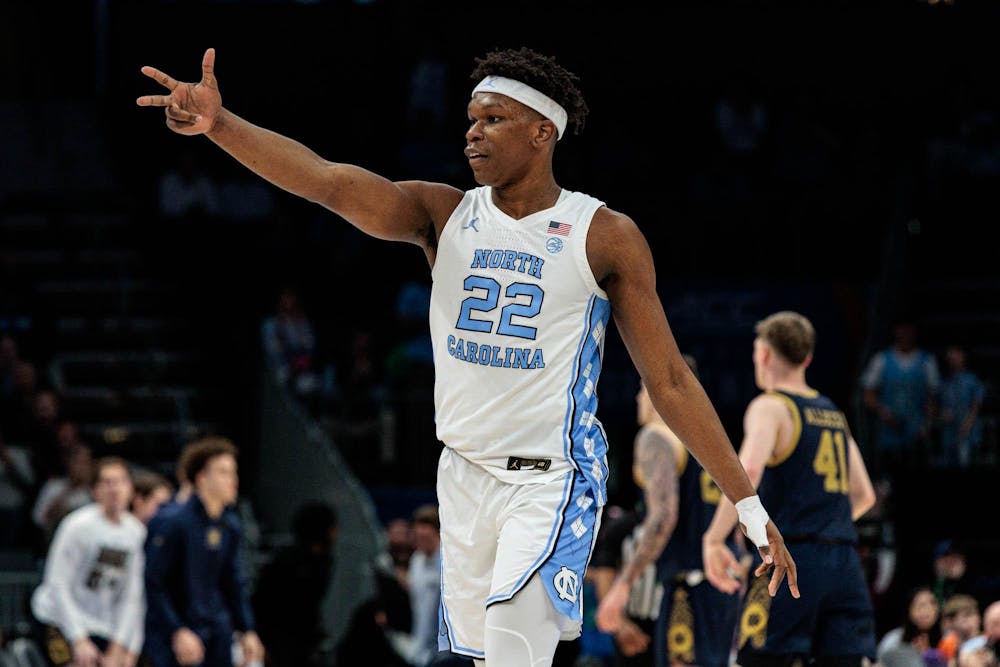
A UNC fan recently asked: “What would you experts do differently with UNC’s roster?” I’m not an expert, but I do have some ideas and today, we’re going to break them down. UNC basketball reportedly spent $14 million building this year’s roster. On paper, that sounds like a team built to dominate. Nationally, though, many agree it feels like an overpay. In my model, I’ve got them ranked 26th — far from the top-3 or top-4 value you’d expect from one of the five highest reported payrolls in the country.
So where did UNC go wrong? Let’s break it down player by player.
Point Guard
If you’re dropping $14 million, you should be targeting elite names — and at a place like UNC, you should have a realistic shot at them. Players like Ja’Kobi Gillespie or Donovan Dent were out there. Instead, UNC ended up with Kyan Evans.
The issue isn’t that Evans is a bad player — he’s fine in a certain role. It’s the price tag of 2 million. For the same reported $2 million, Kansas State landed PJ Haggerty, went for a reported 2.5 million, who I’d much rather have in the role at UNC Evans is expected to fill. Even if you miss on Haggerty, there were cheaper and equally effective options as Evans:
Will Johnston (Richmond) → Same caliber as Evans in my model, but likely signed for pennies on the dollar.
Quimari Peterson (ETSU → Washington) → Another comparable fallback option, and one playing in UNC’s backyard.
The point guard transfer market was weak overall on star power, but this still looks like one of the bigger overpays miscast roles.
Players That Make Sense
Not every signing was a mistake in my opinion. A few actually hit the mark:
Caleb Wilson → Solid addition, though I don’t expect the breakout some predict.
Seth Trimble → Retaining him was smart. His shooting limitations are real, but he’s versatile and talented enough that you had to keep him. He also plays bigger than he is.
Henri Veesaar → Best signing of the group. A high-level get with real upside to be a star.
Luka Bogavac → Excellent pickup. I actually think he wins the point guard battle and emerges as the primary ball-handler, and his stat translations from Serbia check out.
These are the types of signings that justify spending a big portion of the budget — but they’re surrounded by too many questionable ones.
The Questionable Investments
Here’s where things start to fall apart:
Jonathan Powell → Posted just a 9 PER, .506 TS%, and 8 ppg at West Virginia. He makes three’s at a solid rate, but as the likely starting small forward was probably overpaid, similar to Evans. I don’t hate this signing if it was for the right price, but I doubt it was.
Kyan Evans → Fine as a role player, but overpriced and miscast. His 15 PER in the MWC is pedestrian to begin with, and it was buoyed by an unsustainable 65% TS. He doesn’t rebound or facilitate enough to justify the money or the role.
Jarin Stevenson → Underwhelmed at Alabama. After two seasons, another 10 PER and 30% from three doesn’t inspire confidence as a stretch-four.
Jaydon Young → Same issue. Struggled on a 164th-ranked Virginia Tech team, posting just a 9 PER and 29% shooting.
This is where roster construction matters. It’s not just about landing players — it’s about maximizing value across the board.
How UNC Could Have Fixed It
Where I would’ve started is with retaining Ven-Allen Lubin. I think he has a chance to be all conference on NC State.
If UNC had invested more minutes and role in him last year, they likely win more games or at least close the efficiency gap in their metrics. That alone could’ve boosted their ranking and silenced some criticism. Lubin should have been retainable in that scenario and it would have never got to this point. They likely could have retained him regardless if they really wanted him back with promises or money. Infact when he entered the portal he indicated he would be back.
With Veesaar’s ability to shoot a few threes, he would’ve been an excellent fit, similar to how Tobe Awaka paired with Veesaar at Arizona. They played 269 possessions together at Arizona and were +38.4. That duo dominated possessions they played together, and Lubin’s defensive mobility makes him a more ideal at the four than Awaka. He would’ve been a clear talent upgrade over Jarin Stevenson. If you aren’t going to make three’s anyway that doesn’t matter and Veesar would move more in that spacing role on offense with Lubin.
Now let’s say UNC should’ve expected to land Haggerty for the same $2 million they reportedly gave Evans and Haggerty got. That’s a reasonable expectation. Even if not, Will Johnston signed just a couple hours away with Richmond for presumably far less money, there’s no excuse not to land a player like him. With the savings, UNC could’ve targeted a small forward upgrade, where the market was deeper with better options.
Chad Baker-Mazara was the best small forward option — and really the best overall transfer — on the market this offseason. He graded out at 5.3 in our ratings and landed at USC, a place where basketball hardly moves the needle compared to Chapel Hill. His combination of size, scoring, and defensive versatility on the wing would’ve been an ideal fit for UNC’s roster construction and likely gettable. He reportedly was making 1.1 Million with the tigers and mad that one of his new teammates got double that so he left. There is some debate, but he likely signed for 2 million or under. Putting him in that reported Evans 2 million range.
reports indicate one of reasons why Chad Baker Mazara left Auburn was fact he signed a 1.1 million deal to return to that SEC school, then was upset when he discovered Tigers offered transfer Keyshawn Hall double that amount. Field of 68 gets credit for this one. strong reporting…
Just to twist the knife: UNC could’ve taken those savings and gone after Darrion Williams (NC State) instead of Powell. Williams was one of the best overall transfers on the market and a potential first-option scorer. He clearly wasn’t opposed to playing close by, 30 minutes away in Raleigh. UNC had the money, role, and prestige to take him from their rival.
Now, Williams has played nearly exclusively at power forward in his career, but so did Powell, so it’s basically a fair swap. Williams, however, rates highly for passing and ball-handling in pick-and-roll situations and catch-and-shoot opportunities. He likely deserves a chance to try small forward, which could be the carrot to get him to Chapel Hill in this hypothetical. He could still slide to power forward situationally, providing more versatility, outside shooting, and playmaking — areas where he’s clearly dynamic as well.
Another underrated option is Jason Edwards. He’s small at 6’0” and doesn’t provide much passing or creation for others, but alongside a 6’5” guard like Luka Bogavac, he could work for cross-matching on defense. This is a team that started RJ Davis at shooting guard, so it certainly can work. He’s a talented player, rating 4.7 in our model, and if you’re going to spend the money, it might as well be on talent this strong — even if the fit is somewhat less ideal.
Model Comparison: UNC’s Actual vs. Possible Targets
Using my player rating model and realistic replacements likely with in the budget per reporting:
If UNC had gone after PJ Haggerty (4.2 in our model) instead of Evans for the same reported $2 million, or slightly more at 2.5 million as reported, they could have upgraded that spot immediately. With that budget freed, UNC could’ve targeted a likely cheaper small forward likeJalen Celestine at Cincinnati. Again a program that should be beatable.
If those options were too high-profile or unwilling, UNC could likely have wrestled Scotty Middleton away from Tulane. In our model, he’s rated 2.2, virtually equal to Powell’s 2.4, and probably came at a discount. In a slightly different comparison, you could swap Powell for Scotty Middleton at 2.2 or Evans for PJ Haggerty at 4.2, and save some money even or to lock in Lubin for sure.
Even with Haggerty or likely Darrion Williams commanding a bit more, a $14 million budget should’ve been enough ammo to get Williams and assemble a roster with this mix of high-impact and supporting players — maximizing value while staying realistic for a program of UNC’s stature. Haggerty came at a very good reported value for Kansas State..
The Realistic Lineup I Would Have Tried to Build
If UNC had allocated their $14 million more efficiently, this is the starting five and rotation I believe they could’ve realistically landed: (Our Model Ratings)
Jason Edwards (4.7) Another talented option I wouldn’t mind spending a big ticket on if you couldn’t land Baker-Mazara or Darrion Williams (4.9). Jemel Jones would likely be much cheaper than Edwards, but talent is talent — and even if the fit isn’t perfect, sometimes it’s worth taking the best player available and Edwards was one of them. Much like Baker-Mazara and Williams. All three likely came at a similar number to Evans. You should be able to find enough with the savings theoretically on Jones and Johnston as well to pay up to get them and/or have enough for Lubin.
In this lineup Haggerty and Bogavac are interchangable in this version. Trimble is playing back at SF where he spent lots of time last year and rebounded and held up well, but with more size to help than RJ Davis and Elliot Cadeau last year.
This version of the roster has a little bit of everything:
Positional flexibility → Williams could slide into small-ball lineups as a stretch four, making the team more dynamic.
Scoring punch → Jemel Jones is a proven bucket-getter, deployable situationally, or even as a guard who can soak up usage when UNC needs offense. Last year, he ranked fourth in the nation in points per possession, and he did it on a solid 56% true shooting. What’s really impressive is he accomplished that on a team with almost no spacing, ranked 364th in three-point offense. He can score in bunches and deliver a bucket exactly when you need it. He’s heading to New Mexico State, and honestly, he’s easily one of the most underrated players in this cycle. For a UNC team that doesn’t have a clear leading scorer, he fits a real need, and it wouldn’t shock me if he emerges as a key player.
Stability at point guard → Johnston grades out as very comparable to Evans in my model, but in a role that fits better. Even if he were forced to start, he wouldn’t be a downgrade.
Upside development → Caleb Wilson could be worked into the rotation without heavy expectations, giving him time to grow into his role.
Balanced burden → Less responsibility would fall on Trimble’s shoulders, allowing him to play to his strengths instead of being forced into doing too much.
Overall, this group blends floor spacing, defensive versatility, scoring options, and depth — while staying within a realistic $14 million build. In my model, this roster grades out at 3.8 overall, comfortably a top-5 team, which is far more befitting of the budget UNC actually spent.
Final Word
I’m not an expert, but if it were me, I’d have spread UNC’s $14 million differently. With the budget they reportedly had, and the caliber of realistic players available to a program like UNC, the roster could’ve been built into a top-5 team in my model. Instead, it feels like they missed out on better value for the price paid.