The performance of top Division II (D2) basketball teams against Division I (D1) competition has long been a fascinating question to me. Historically, the best D2 teams I’ve often estimated to be comparable to mid-level D1 programs ranked between 100th and 150th. Anecdotal evidence supports this, with high-profile non-D1 teams occasionally upsetting D1 opponents in preseason exhibitions or real games. Canadian powerhouse Carleton, for example, has been likened to a strong Colonial Athletic Association (CAA) team by some coaches, however my extensive research showed them to be more capable, further fueling the debate. However, these comparisons largely arise from isolated games rather than an entire season’s performance, leaving room for speculation about how a top D2 team might fare across a D1 schedule.
Massey Ratings has an interesting site where they rank all of college basketball across divisions. Here are how some of the notable teams we will touch on ranked last year.
Over the last 25 years, several successful non-D1 programs have transitioned to D1, offering insights into this question. Schools like Belmont, Cal Baptist, St. Thomas (from D3 Journey written about here), South Dakota State, and Bellarmine all achieved varying levels of success after making the jump. Notably, these programs often relied on strong D2 or NAIA pedigrees, supplemented by D1 transfers, to remain competitive during the transition.
Two years ago I wrote about Lincoln Memorial University (LMU), under coach Josh Schertz, stands out as one of the most dominant D2 programs, with multiple Final Four appearances and a stellar 32-1 season in 2020 cut short by COVID-19. Schertz’s move to Indiana State has further connected the D2 and D1 narratives.
Indiana State’s roster that season reflected the core of LMU’s success, with former LMU stars Courvoisier McCauley, Cameron Henry, and Xavier Bledson leading the team alongside several other D2 transfers. This group has effectively re-formed the peak LMU lineup under Schertz in a D1 setting, achieving a 100th ranking on Kenpom that season, demonstrates how a top D2 team potentially could thrive in D1 when retaining its core players and recruiting similarly. The team’s success provides a compelling case study for how a dominant D2 program like Lincoln Memorial might have performed had it made a direct leap to D1 competition.
Drake/Northwest Missouri State
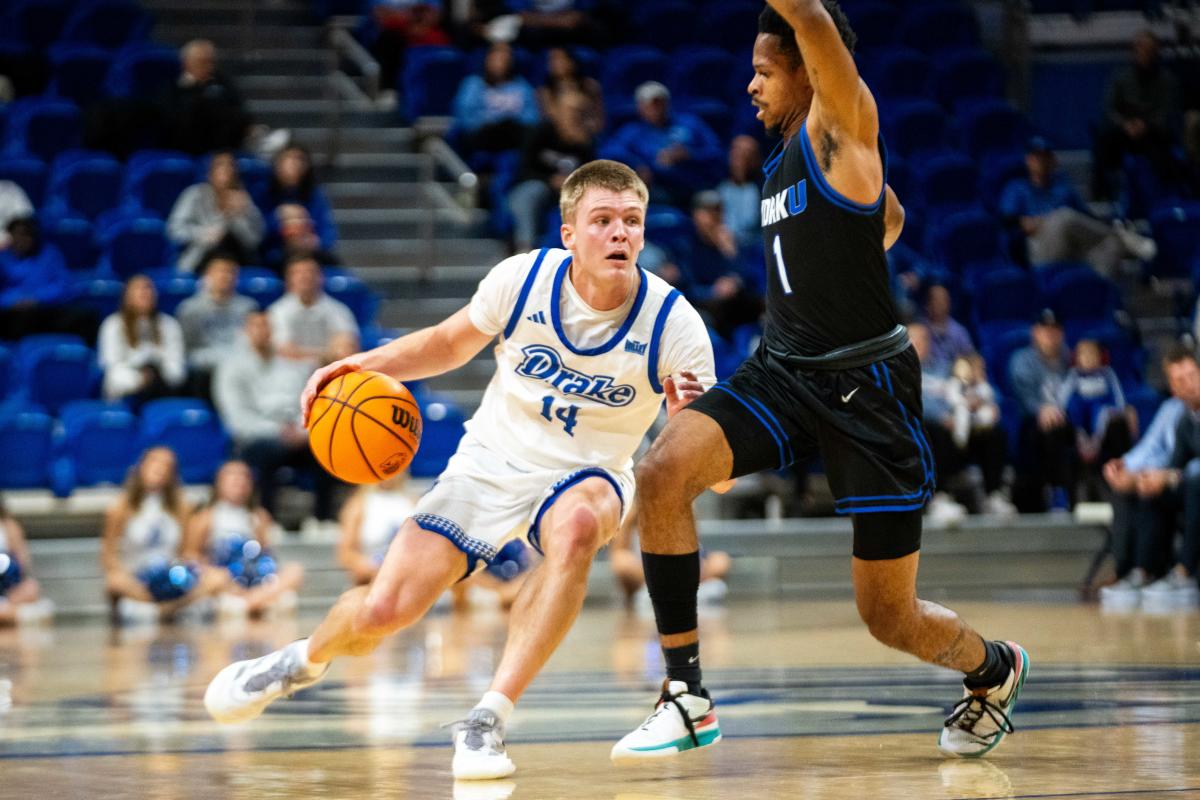
This season, however, there is a better comparison, in my opinion, with Ben McCollum taking four starters from his top-5 D2 team to Drake. McCollum won four D2 National Titles in five seasons, and it would likely have been six if COVID hadn’t canceled the tournament, as his team was 31-1. Perhaps the most interesting storyline is that Drake hired Ben McCollum from Northwest Missouri State, where he won four national championships and had the #1 team during the COVID-canceled season, which would have likely been his fifth. He brings over four starters from a 29-5 team that finished 4th in the nation last year. The one starter they lost was 6-7 All-American Wes Dreamer, who averaged 17.8 points and 6.4 rebounds per game.
Unfortunately, McCollum lost his D2 All-American, but he added a high-quality mid-major transfer in Cam Manyawu, who was ranked 381st in our model. This was a big addition they likely wouldn’t have had in D2, and he fits the position they lost with the D2 All-American, who was likely comparable. With him and the returning D2 players, we ranked Drake 123rd in the preseason, considering they lost every other key contributor. The only returning player for Drake was a 14-minute-per-game role player, and the only other notable addition after Manyawu was a JUCO role player. This is likely the closest comparison to any really good D2 team moving directly up while retaining its core in the NIL-free transfer era.
It’s worth noting that this wasn’t even a vintage top-level Northwest Missouri State championship team— like the 2019 version ranked 66th nationally by Massey, or the 2nd best ranked team 106th that was robbed of another championship. At 177th last year they seemingly lost a step, which is why we projected Drake 123rd.
Cal Poly/Colorado Mesa
Cal Poly has a similar situation bringing 4 D2 starters. It’s why we highlighted them as a top sleeper team in the rankings. Mike DeGeorge is in his first year after coming off a 29–5 season, where he made the Sweet 16 at Colorado Mesa. He compiled a record of 141–43 (.766) over six seasons there. DeGeorge will bring four players with him from this program that was 6th in the D2 last year, including three starters, all of whom can shoot threes, providing a strong foundation for the team. The difference we saw here was they also lost a D2 all american but did not add a players like Manyawu to offset it.
Paul Corsaro led Indianapolis, a D2 school, to a 23–9 record and a #21 ranking, following three straight years in the top 25. Taking a job in the same city, he brought with him two of his top players, along with Jarvis Walker and Paul Zilinskas from Indianapolis.
Conclusion
What seems apparent now is that Drake appears to be much better than a top-100 team after watching them win a strong Charleston Classic field. At least in this game, they were one of the most impressive teams I have watched all season, moving to 6-0 with wins over Vanderbilt, Miami, and FAU. This will be another interesting case study on how a core from D2 performs.