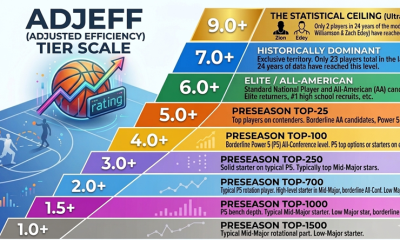
Sincere Parker should be captivating the basketball world, yet he remains largely overlooked. He graded out as a top-100 player in our rankings despite playing only 20 minutes per game last season—a testament to how off-the-charts his per-possession stats were after my minutes adjustment. That said, even I had concerns about whether his production was sustainable. After all, it came in just 16 games, with no prior history in JUCO or his first season at Saint Louis of performing anywhere near this level statistically. In fact, I can’t recall another guard who has played at this level before. Adding to the intrigue is that he did most of his damage in the Atlantic 10, a highly competitive league coming in mid season after 2 months with a broke foot.
The questions about Parker’s performance appear to be answered, as he is posting a Player Efficiency Rating (PER) of 31.0 early this season as well. The remarkable part? As a 6’3” guard, he’s achieving this without relying on three-point shooting, connecting on just 7-of-25 attempts (28%) through six games. Instead, Parker is dominating inside the arc, shooting an astounding 30-of-43 (69.8%) on two-point attempts and earning frequent trips to the free-throw line.
Last season, Parker shot 42.6% from beyond the arc on a solid 7.4 attempts per 40 minutes. If he can regain that level of three-point accuracy this year, he’ll be unstoppable. Simply put, Parker is cooking, and it’s time more people paid attention. His most recent showcase—a 31-point explosion against a 6-0 Longwood team—underscored his efficiency. Parker hit an absurd 12-of-14 from two-point range in just 26 minutes, a performance reminiscent of the dominance we usually associate with towering centers like Zach Edey. He’s the most efficient guard certainly since he came back from injury and one of the most efficient we’ve seen.
A Scoring Machine in Limited Minutes
Parker is averaging 17.7 points per game in only 21.3 minutes—a staggering level of productivity. This follows a breakout season where he averaged 15.9 points and 4.3 rebounds in 20.7 minutes over 16 games. Despite missing much of the early season last year due to a foot injury, Parker delivered some jaw-dropping performances upon his return in the last 18 games he’s played:
- 33 points in 18 minutes vs. LaSalle.
- 34 points and 9 rebounds vs. St. Joe’s.
- 30 points against VCU.
- 21 points in 21 minutes vs VCU
- 31 points in 26 minutes vs Longwood
- 19 points in 21 minutes at Alabama.
His dominance in Atlantic 10 play was especially notable, as he posted a PER of 36.0 across 12 conference games and 15.5ppg in 19.6 minutes, even better numbers since the injury, showcasing his ability to thrive against quality competition in a high major conference. What was perhaps more remarkable is these weren’t outrageous unsustainable numbers, like a player shooting .50%+ from three. He did it with a .595% true shooting in the 16 games overall and .618% in the 12 A10 games. It was also fueled by high level rebounding for a at St Louis both years at over 11 rebounds per 100 possessions. He’s only at 6.3 so far this year at McNeese so he still has room to potentially grow there as well. Achieving these numbers while not even hitting three’s or his historical rebound rate makes it more impressive.
Historical Comparisons and Questions About Playing Time
Parker’s efficiency is drawing comparisons to national stars like Zach Edey. He averaged 44.2 points per 100 possessions last season—just shy of Edey’s scoring rate. Now this season he is at 47.4. However, Parker’s production is even more striking given his relatively limited minutes similar to how Edey was used. It’s baffling why he hasn’t been given a larger role, considering his clear ability to take over games.
Despite his dominance, Parker remains somewhat of an enigma. His freshman season at Saint Louis was unremarkable (5.9 points, 2.5 rebounds, 18.1 PER), and his breakout last year came in just 16 games. While his JUCO pedigree suggested potential it was never close to this level of production, few could have predicted this level of performance after his first year at St Louis.
A Star in the Making?
Parker’s unique trajectory makes him one of the most intriguing players in college basketball. His ability to score at an elite level in limited minutes, coupled with his out-of-nowhere rise, makes him a compelling figure. However, questions about sustainability linger if he will get the opportunity to shine in expanded minutes. Once conference play hits it’s doubtful most people would even notice regardless one of the worst conferences in the nation.
Still, Parker’s upside is undeniable. Teams across the country would be wise to take notice of a player capable of single-handedly altering games. The only real mystery is why he’s not on the court more often. There is no excuse now that he is well past his injury. With his remarkable efficiency, elite scoring ability, and untapped potential, Parker deserves to be a focal point for his team—and a name on everyone’s radar and come NCAA tournament time he makes McNeese an even more dangerous team for an upset or two with his upside.
Bottom Line: Play this man.