Over the past few years, we’ve seen a growing trend of Division II (D2) basketball players making the jump to Division I (D1) programs. While not all have found success at the highest collegiate level, a number of players have defied expectations and carved out impactful roles in their new environments.
Notable success stories include Ryan Hawkins (D2), Duncan Robinson (D3), Max Strus (D2), and Derrick White (D2), all of whom leveraged their skills to make a significant mark in D1 before moving on to professional careers. But how did the latest group of D2-to-D1 transfers fare in 2023-24? Let’s take a look at the performance of the 2023 class of D2 transfers and see how they adapted to D1 competition.
The Challenge of Moving from D2 to D1
Transferring from D2 to D1 is often more challenging than moving between D1 programs, particularly from lower-tier schools to Power 5 conferences. Players from non-D1 programs face more uncertainty, as the level of competition and the demands of the game increase significantly. Even highly successful D2 players aren’t guaranteed to make an immediate impact at the D1 level if they jump to a level to high.
For instance, past transfers like Bryan Griffin, Robbie Heath, Dale Bonner, and Cam Martin all struggled to replicate their D2 success in D1. Despite impressive resumes, they often found it difficult to adjust to the elevated competition or secure meaningful playing time.
One key example is Qua Grant, who initially struggled at Wichita State but found his footing after transferring to Sam Houston State, where he led his team to the NIT. This underscores the importance of context and finding the right level and team for a player’s skill set. JT Shumate at Toledo is another example of a D2 player who found major success after making the jump.
Why Some D2 Players Succeed
Our research has shown that certain player profiles tend to translate more successfully to D1. Strong shooters and rebounders are often able to carry their skills over to the higher level of play. This is especially true when they join programs that can maximize their abilities in areas like floor spacing or rebounding.
In recent years, more and more D2 All-Americans have made the leap to D1, often with great success. The 2022-23 College of Charleston team is a prime example, finishing 31-4 and relying heavily on the contributions of three former D2 All-Americans: Dalton Bolon, Ante Brzovic, and Pat Robinson. All three were double-digit scorers and played key roles in the team’s success. This trend isn’t limited to D2 talent alone, as we’ve seen NAIA All-Americans also transition to D1 and make an impact.
2022-23 Results
In the 2022-23 season, several Division II and NAIA transfers made notable impacts at the Division I level, showcasing the potential of players moving up from lower divisions. Isaiah Moore, a former D2 All-American from Franklin Pierce, excelled at South Alabama, averaging 18.9 points, 3.3 rebounds, and 4.6 assists per game in 33.5 minutes after averaging 22.6ppg, 5.4apg in D2. Pat Robinson, another standout from West Liberty, also shined at the College of Charleston, contributing 10.3 points and 3.1 rebounds in 19.2 minutes per game after averaging 20.3ppg 4.6rpg in D2 as an All American for a top team. Phillip Alston, who averaged 21.0 points and 10.8 rebounds at the D2 level with California University of Pennsylvania, was expected to be a key contributor for Loyola Chicago. While not all transfers had immediate success, many demonstrated the ability to adjust to the higher level of competition. Patrick Cartier, a D2 All-American from Hillsdale, transitioned smoothly to Colorado State, averaging 12.3 points and 3.1 rebounds in 21.9 minutes after averaging 22ppg 6rpg as an All American in D2. These players’ performances illustrate that strong D2 and NAIA talent can translate effectively to the D1 stage, particularly when given the right fit and opportunity.
Evaluating the 2023 D2 to D1 Transfers
As we turn our attention to the 2023-24 season, it’s clear that this year’s crop of D2-to-D1 transfers. With 80 players making the leap from D2 to D1 in 2023, the results have been mixed, but a few standout performances deserve attention:
Jalylen Wells
Wells was the most successful D2 transfer this season, playing a pivotal role in helping Washington State achieve a second-place finish in the Pac-12 and secure a victory in the NCAA tournament. He averaged 12.6 points, 4.6 rebounds, and 1.2 assists with an impressive 18.6 PER. Wells’ three-point shooting was particularly effective, hitting 41.7% of his attempts on 70 makes. At Sonoma State, he averaged 22.4 points and 8.7 rebounds per game, shooting 43.8% from three-point range, though he made only 46 three-pointers.
Joel Scott
Scott was a key player for Colorado State’s at-large NCAA tournament team last season, averaging 13.1 points, 6.1 rebounds, and 1.4 assists, with a notable 22.7 PER. Alongside fellow former D2 All-American Patrick Cartier, Scott played a crucial role in solidifying the post position. Previously, Scott had averaged 23.2 points and 10.7 rebounds per game at Black Hills State. The only skill that didn’t translate was his .396% three point shooting on 126 makes in D2.
Jack Gohlke
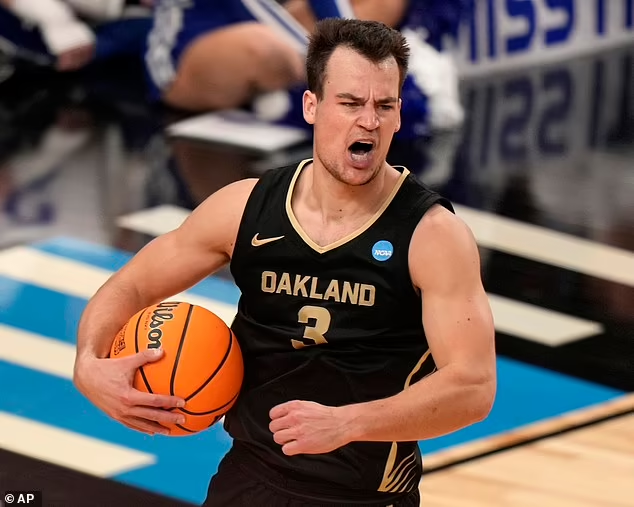
Gohlke is the most recognizable name on this list after leading Oakland to a stunning upset over Kentucky in the NCAA tournament, hitting 10 three-pointers and scoring 32 points. Over the season, Gohlke averaged 13.1 points, 4.1 rebounds, and 1.1 assists for Oakland, numbers nearly identical to his 14.2 points, 4.2 rebounds, and 2.3 assists at Hillside. The main difference was an increased focus on three-point shooting, with Gohlke averaging 3.81 made threes per game in D1 compared to 3.27 in D2. Oakland has a strong tradition of producing elite three-point shooters, making it the perfect fit for a player with Gohlke’s shooting ability.
Rasheed Bello
Bello led all D2-to-D1 transfers in scoring, averaging 14.9 points, 2.9 rebounds, and 4.3 assists, while contributing to Purdue Fort Wayne’s successful 23-win season. His numbers were close to his performance at Wisconsin-Parkside, where he averaged 17.9 points, 5.1 rebounds, and 4.5 assists.
NAIA
Riley Minix
Minix averaged 25.4 points, 13.6 rebounds and nearly 3.0 assists per game in 2022-23 in NAIA and transitioned to Morehead State where he averaged 20.9 Pts, 9.7 Reb, 2.2 Ast with a 30.7 PER. Morehead State finished 26-9 and was a 14 seed in the NCAA tournament.
Ben Humrichous
Ben Humrichous averaged 14.7 Pts, 4.7 Reb, 1.9 Ast 21.8 PER at Evansville at Huntington in 2022-23, he averaged 12.8 points and 5.2 rebounds per game. He improved his statistics moving to a top 10 conference.
Mason Walters
Walters is our standout NAIA player this season. He averaged 12.2 points, 5.4 rebounds, and 2.0 assists for Wyoming, demonstrating his capability at the Division I level. The previous season, Walters was the NAIA Player of the Year, averaging 26.7 points and 9.5 rebounds per game, and he had averaged as many as 11.7 rebounds per game in earlier seasons as a three-time NAIA All-American. Despite Wyoming’s losing record, they were competitive in Mountain West Conference (MWC) play, finishing 8th with an 8-10 conference record. Notably, six teams from the MWC advanced to the NCAA tournament, and the 7th team went to the NIT.
These players, along with others in the 2023 transfer class, highlight the diverse outcomes that can result from moving up a division. Some have seamlessly transitioned, becoming key contributors on their new teams, while others are still adjusting to the pace and physicality of D1 basketball. Overall there seems to be more D2 players having success than previously when we studied it.
My theory is that mid-major conferences are being thinned out by the effects of NIL and the transfer portal, creating more opportunities for D2 transfers than just a few years ago. Meanwhile, power conferences are consolidating talent from lower levels, leaving a wider gap between the two tiers.
One lesson that remains consistent across both years is the importance of fit. A D2 player moving to D1 doesn’t just need to bring talent—they need to land in a program that can utilize their strengths. The key is water finding it’s level. Some players, like Qua Grant, found success after switching schools multiple times, proving that persistence and finding the right system and level can make all the difference. Where as others like Dale Bonner shot a little to high to make a real impact.
As we continue to monitor the performance of D2-to-D1 transfers in the 2023-24 season, one thing is clear: while the road is tough, there are players who can thrive with the right mix of talent, and opportunity in a mid level conference for the most part.