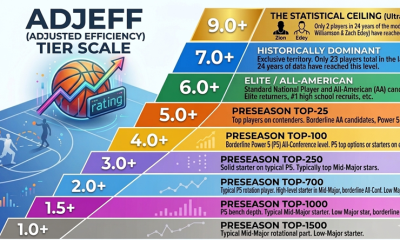
Evaluating international basketball prospects entering NCAA college basketball requires an understanding of how their overseas statistics translate to the U.S. game. Competition levels vary significantly from league to league, so raw numbers alone rarely tell the full story. This article provides a league-by-league translation, comparing major international leagues and the NBA G League to NCAA conferences using a custom strength-of-schedule scale that feeds directly into my statistical model.
This framework helps coaches, scouts, and fans better interpret a prospect’s production overseas and project how that performance is likely to translate to college basketball. One of the most useful tools in this process is Player Efficiency Rating (PER), which is available for most professional leagues and provides a common baseline for comparing players across vastly different environments.
I’ve spent more than two years refining these calculations, using multiple AI models to help rank nearly 50 international leagues relative to NCAA competition. After last year’s initial release, I compared the projections to actual college results, reverse-engineered where the model was too aggressive or too conservative, and adjusted the league weightings and minute-based factors accordingly. The result is a significantly improved translation model that provides a more accurate estimate of which international prospects are most likely to make an immediate impact in the NCAA.
2025 International Prospects Under the Tweaked Translation Model
Last year was my first attempt at building an international statistical translation model. After comparing those preseason projections to each player’s actual ADJeff rating in college, I went back and adjusted the league-strength weightings, minute-based penalties, and other translation factors. The table below provides a spot check of some of last year’s most notable international prospects, showing their projected ADJeff rating next to their actual result. By comparing the two, we can identify where the model was too aggressive or too conservative and use that information to improve the 2026 rankings. These were the top-referenced prospects last season.
| 2025 | ADJeff | Projections | Actual |
|---|---|---|---|
| Hannes Steinbach | Washington | 5.043 | 6.28 |
| David Mirkovic | Illinois | 3.213 | 5.18 |
| Thijs De Ridder | Virginia | 4.202 | 4.85 |
| Sananda Fru | Louisville | 5.775 | 4.82 |
| Ivan kharchenkov | Arizona | 3.200 | 4.10 |
| Johann Gruenloh | Virginia | 3.700 | 3.82 |
| Stefan Vaaks | Providence | 4.480 | 3.50 |
| Ruben Dominguez | Texas A&M | 2.036 | 3.19 |
| Mario Saint-Supery | Gonzaga | 3.162 | 2.92 |
| Luka Bogavac | North Carolina | 3.680 | 2.91 |
| Neoklis Avdalas | Virginia Tech | 2.780 | 2.68 |
| Dame Sarr | Duke | 1.995 | 2.63 |
| Omer Mayer | Purdue | 1.074 | 1.64 |
The strongest proof of concept for this model came from last year’s translations of the Basketball Bundesliga, where the projections significantly outperformed the mainstream consensus. While some national systems ranked Sananda Fru outside the top 500 and Hannes Steinbach outside the top 300, my model identified both as high-impact prospects from day one. Fru largely validated that projection, finishing with a 4.82 ADJeff and ranking close to the 5.3 my orginal formula had him last preseason, 12th in the Bart Torvik ACC Player of the Year standings and 84th overall nationally, powered by a top-40 offensive rating and the second-highest field goal percentage in the NCAA. Steinbach was even more precise, finishing 14th in both my final rankings and Torvik’s national POY leaderboard. Meanwhile, highly touted prospects such as Dame Sarr and Omer Mayer were viewed more cautiously by the model, a skepticism that proved justified once the season began.
2026 International and Professional Prospect Rankings
Using my updated international translation model, these rankings project how top overseas and professional prospects are expected to perform in NCAA basketball based on their adjusted production, league strength, and minutes played. Each player is assigned a projected ADJeff rating, placing them on the same scale as returning college players and allowing for direct comparisons across all levels of competition.




College Basketball
2026-27 Preseason College Basketball Projections: AdjEff Model

College Basketball
2026-27 Preseason College Basketball Player Ratings: AdjEff Model

College Basketball
Refining the Lens: The 2026 International-to-NCAA Translation Model


College Basketball
Transfer Portal Basketball Rankings 2026


College Basketball
Summer Clearance: Bargain Bin Shopping in the Portal


College Basketball
The Top 300 Returning Players

College Basketball
Top 200 transfers by Adjusted Efficiency