In the 2026 college basketball landscape, the divide isn’t just between the “haves” and “have-nots”—it’s between the “massive spenders” and the “mathematically eliminated.” With top-tier Power Conference rosters now exceeding $8 million to $10 million on average in combined NIL and revenue-sharing, and some examples in the recent past in the $14 million to $22 million range, mid-majors and low-resource P5 programs are facing a crisis of traction. We’ve seen this come to fruition in the last two years with the chalky NCAA tournaments at the same time the NIL funding has become the most ridiculous. In fact, the SEC of two years ago might be the best example that even the 13th or 14th best team was so dominant and getting bids with 6-12 conference records. To be clear, they were that good and deserved them in my opinion. This creates a clear disadvantage for anyone without money to even get in the game.
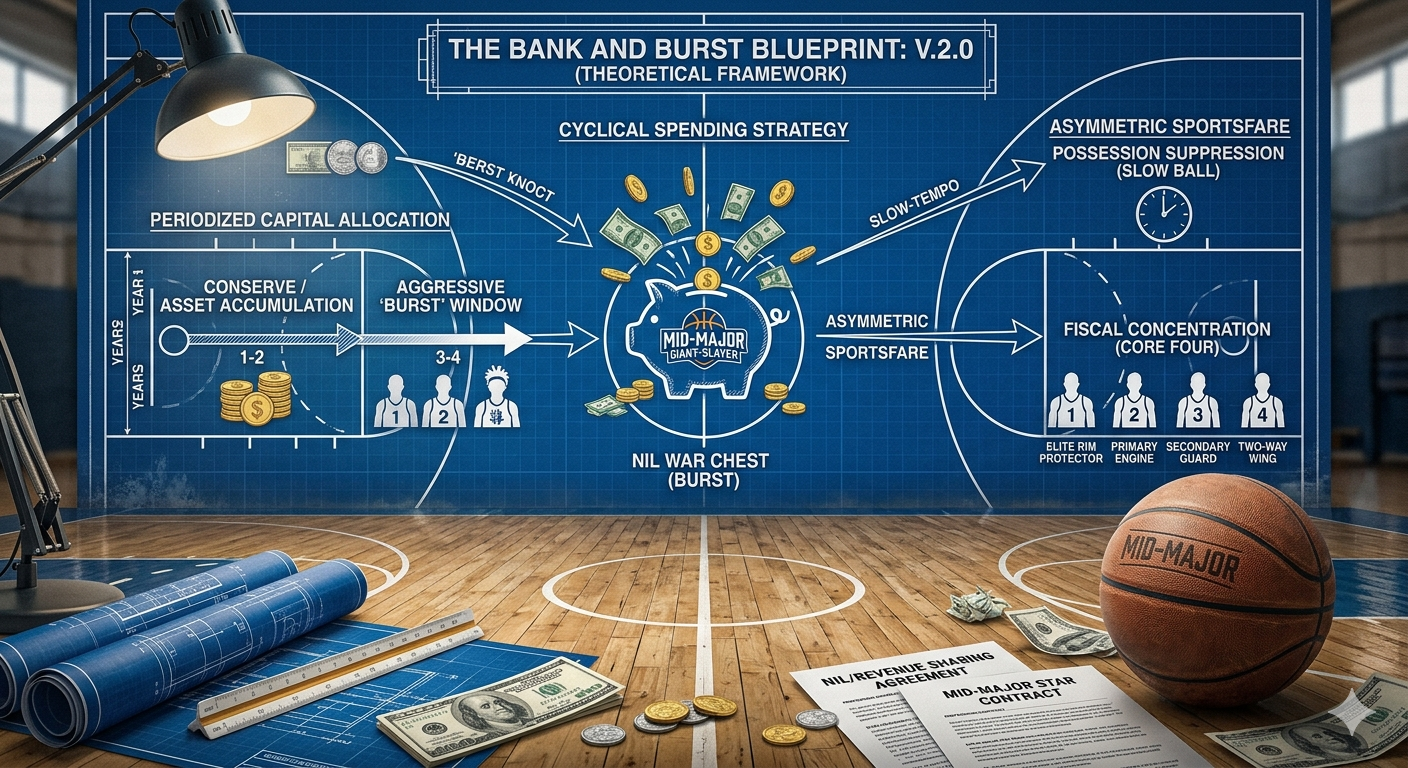
To survive an environment defined by eight-figure Power Conference budgets, underfunded programs must abandon the pursuit of annual “respectability” and embrace a Framework for Asymmetric sportsfare. This requires a fundamental shift in how we view the college basketball season, moving away from a year-to-year survival mindset toward a Theory of Periodized Capital Allocation. By utilizing a “Bank and Burst” model, programs can strategically weaponize financial windows, pairing Fiscal Concentration (the “Core Four” investment strategy) with tactical Possession Suppression. The goal is no longer to match the goliaths dollar-for-dollar, but to manipulate the variables of time, pace, and purse strings to ensure that when a program strikes, it does so with the force of a Top 25 contender.
To compete for NCAA Tournament runs or at-large bids, these programs must stop attempting to match annual spending and start operating like small-market NBA front offices. It is time for the Cyclical Spending Strategy, or what I am envisioning and calling the “Bank and Burst” model.
I’ve spent the last few years trying to think of the best ways mid-majors and underfunded programs could best compete. This is an extension of those ideas and my newest addition here. If you’d like to take a look at how to spend funds for the best roster structure, I’ll add those updated ideas at the end of this article again to continue building on gaming out the best way to compete in the NIL era.
1. The Logic: Financial Windows vs. Annual Attrition
Let’s say the traditional model for a low-resource mid to upper-level mid-major program (say 100th to 125th) is to spend its modest budget (e.g., maybe $1 million to $1.5 million a year) every single year just to maintain a baseline level of play at this level. The result? A perpetual “middle-of-the-pack” thinking even at the level you play, likely where the top teams in the conference have maybe 75 to 100 type of money.
The Bank and Burst strategy I am proposing suggests that a program should intentionally “under-spend” during more or less imposed rebuilding years to create a massive “war chest” for specific windows of contention. Not just within the conference, but to have their best chance to compete beyond and maybe sneak into an at-large or a better than 12th or 13th seed so they stand a better chance at a run. No one is saying you have to lose those years; if you are smart and find undervalued gems, you should still be able to compete for the upper half of your conferences and find players perhaps you stand a better chance of retaining in the years you do spend. Your best players are going to always ask for more money anyway; if you start with lower-paid ones, you stand a better chance to move up and pay them later anyway. If you just spend $1.5 million or the equivalent with inflation every year, you are never able to really pay more without taking from other areas on your capped salary structure.
The 2-Year “Burst” Cycle
I’d propose a conservative year and a Burst year. So if you have a $1.5 million baseline to spend on a roster, instead you spend $500k in Year 1, and find the best gems and undervalued players you can to compete. Year 2, you take that $1 million held back and have $2.5 million for your burst year. If you did well recruiting, you stand a better chance of paying and keeping the cheap guys you found and then filling in the weaknesses and having a real chance to compete in that year.
The 4-Year “Burst” Cycle
If you really want to get aggressive, perhaps you could operate under a 4-year plan where you conserve for 3 years and then really go for it in Year 4. This is probably less realistic for most coaches and probably even some plans, but in theory, it would probably be the best for coaches to maximize and move on. For one, you don’t raise the bar early and then fail to meet it later, which is easy to do with the same resources each year. Basically, you game the system and learn the school and how to recruit to it the first 3 years, and then Year 4 you go for it. You stand to have a good chance to win with a massive relative budget and punch your ticket to the next job.
2. Identifying “Undervalued Gems”
In “Bank” years, the goal is market efficiency. Instead of overpaying for mediocre experience and getting what you always get, programs should hunt for:
- The “Bounce Back”: High-major bench players with elite metrics but low playing time, especially those that proved it at your mid-major level and are on the way back down, especially those that want a higher role again or to be closer to home. Those are the value, IMO.
- Low-Level Standouts: Those as well as D2 or low-majors with high per-possession value.
By spending only $500k in Year 1, you aren’t “punting” the season; you are identifying who is worth a $500k individual “max,” which should be easier to do for the lower-level targets. If you miss, it’s not the biggest deal.
3. Avoiding the “Walking Dead” Trap
One of the greatest drains on school resources is the desperation spend. When a coach is on the hot seat—the “walking dead” phase—collectives often feel pressured to dump resources into a mediocre roster to “save” the season. Move on from those coaches or write them off and give them the Bank year and save that for the next coach is the prudent way to go.
The Bank and Burst model requires clinical detachment: If the leadership is unstable or the talent isn’t hitting, lower expectations. Don’t spend $2 million to finish 10th if the coach is the issue. You need coaches that max or exceed the sum of the parts. Spend $500k, finish 11th, and save that $1.5 million for the next cycle when you have a coach or a core you believe in. This should be pretty apparent by what they do with the resource levels they have.
4. The NBA Parallel: Strategic Rebuilding
In the NBA, teams have shown that periodized “tanking” or asset accumulation is the only way for small-market teams to eventually out-talent the big-market spenders by taking the lumps and making smart moves.
For a mid-major, “financial tanking” for a year or two allows them to field a better roster in Year 2, 3, or 4—however you set that up—that, with smart value gems and an accumulated war chest, could legit have the talent of a Top 25 program. That’s not really happening in this current environment. This is the best way perhaps to achieve that. This is likely the only way to secure a protected seed or a deep tournament run without relying solely on a “genius” coach like Ben McCollum, who will likely be poached anyway in short order.
5. Why the “Burst” is Hard to Execute
While the math is sound, the execution faces two primary hurdles:
- Coaches: A coach’s survival is year-to-year. Very few have the job security to tell a fan base, “We are saving our NIL money for 2028.”
- Donor Psychology: Boosters want to win now. Asking a collective to sit on $2 million while the team struggles is a massive “ask” in an era of instant gratification. You are going to need to have everyone on board and this as a known and accepted plan from the start, with everyone working for the burst years.
For the mid-major or the low-traction P5, the choice is clear: spend small every year and hope for a miracle, or bank your resources and strike with your version of a “super-team” once every other year or even four years to match with the cycle of a new coach. In the professionalized world of 2026, the latter is the only one that balances the books and leverages the system towards the “have-nots.” Perhaps it could even be deployed higher up the food chain to give lower or even mid-level P5s a chance at a top 3 seed and to contend.
If you are interested in previous ideas around NIL and maximizing strategies and roster construction I’ve written about in the past, here are some of the cores of those ideas.
The Mid-Major Blueprint: Strategic Survival in the Revenue-Sharing Era
The college basketball transfer portal has transitioned from a roster-building tool into a high-stakes financial war. For mid-majors and “low-resource” Power Four programs, the challenge intensifies annually as talent gravitates toward the highest bidders. We are seeing the end of the “slow-build” era; the moment a mid-major prospect flashes star potential, they are often poached by programs with vastly superior budgets.
To compete, schools must move away from “communal” roster building. Success in an uneven landscape requires a concentrated allocation of capital. It is no longer about matching a $10 million budget—because you can’t—it is about ensuring your $1 million is spent on the right few players. We think, in general, the fewer are better, as long as they are worth the value. Four being the ideal.
The “Core Four” Investment Strategy
Spreading resources thin is the most common mistake in the current market, in our opinion. A roster full of “solid” players results in a mediocre season. Instead, programs should aggressively overpay for four high-impact archetypes and fill the remaining gaps with cheap specialists. Trust that your evaluations and finding value is easier the closer to replacement level you get. It’s much easier to find a player valued like the 2,500th best player and have them emerge to be the 1,000th best than paying for the 600th best and hoping he emerges and plays like the top 200. It is a logarithmic scale where it gets tougher the higher you go, or in this case, the more you expect.
I think the best strategy is to pay for the best, most underrated proven players you have access to at your budget. The fewer the better. If I could spend what I had and get the best players, say even top 100 nationally, you do that and figure the rest out; that is a better strategy. If one of your best players gets hurt, the season is probably mostly over anyway. I wouldn’t spread it out.
1. The Vertical Spacer (Elite Rim Protector)
A dominant shot-blocker is the single most effective defensive force multiplier. An elite rim protector allows perimeter defenders to be lesser on defense, knowing the interior is secure; you can have more shooting specialists and still be covered. These players don’t require high offensive usage; they thrive by controlling the boards, catching lobs, and altering shots at the rim. For mid-majors, securing the best rim defender available to their budget would be a great start and a top priority in NIL spending money, in my opinion. I wouldn’t mind overpaying a little or not cheaping out here.
- The Profile: Look for high-efficiency “dunkers” and finishers over “post-up” bigs. You need the easier, efficient shots or you are starting at a disadvantage.
- The Value: Defense and high-percentage finishing are the floor. This archetype stabilizes your efficiency on both ends without demanding high offensive usage. A single great interior defender can raise the floor on defense significantly.
2. The Primary Engine (Lead Guard)
A true lead guard is essential for the offense to function, breaking presses and creating shots. This player should be able to create offense, break down defenses, handle pressure, and facilitate scoring opportunities. Without a reliable point guard, ball movement stagnates and the offense becomes predictable. Investing in a dynamic lead guard is an important starting point and crucial to maintaining a functional offense.
Preferably, I would prefer a bigger PG, but you take the best here. Without a dynamic playmaker, an offense is dead on arrival. A lead guard must be able to navigate full-court pressure, navigate ball screens, and create late-clock opportunities.
- The Preference: Target size. A 6’3” or larger point guard provides defensive versatility and sightlines that smaller guards lack. It also allows you to take smaller three-point specialists and cross-match on defense.
- The Preference: Target size. A 6’3” or larger point guard provides defensive versatility and sightlines that smaller guards lack. It also allows you to take smaller three-point specialists and cross-match on defense.
3. The Multi-Dimensional Secondary Guard
The “Insurance Policy.” This player must be comfortable off-ball with spot-up shooting (above average from three), but capable of initiating the offense when the lead guard is pressured or on the bench.
- The Strategy: A combo guard who can make threes and play off the ball, or create their own shot, gives the defense more to think about.
4. The Two-Way Perimeter Wing
Efficiency is king. A “specialist” shooter who cannot defend becomes a target in March. You should be able to find those for cheap. This is the best of both worlds you can reasonably afford with some decent size. While shooting is vital, a pure shooter without defensive ability becomes a liability in key moments. The ideal investment is a two-way wing who can hit shots at a high percentage (38% or better from three) while holding their own defensively, likely at least 6’4” plus. This type of player provides balance on both ends of the floor and ensures versatility in late-game situations.
- The Target: A wing shooting 38% or better from deep who possesses the lateral quickness to switch defensively. This balance ensures your best players don’t have to be subbed out during winning time.
This is the “Core Four” and they should be able to play together. You do not want overlap here.
Filling Out the Roster
Once the core four players are secured, the remaining roster should be built with budget-friendly options:
- Proven shooters who don’t require high usage.
- Experienced transfers from lower divisions.
- Specialists who excel in specific roles without large NIL demands.
Prioritizing Scoring
Efficient scoring is harder to replace than defense. While defensive specialists can be found at lower costs, high-level offensive players are scarce. The NBA provides a useful comparison—offensive stars receive max contracts, while elite defenders without scoring ability often remain role players if they can get on the court at all. Mid-majors and schools with fewer resources should follow this principle by prioritizing shooting and offensive efficiency. Would a Tony Allen even get in an NBA rotation today? He certainly wasn’t being maxed out even a decade ago. Meanwhile, James Harden could be a traffic cone and was still massively important. Offense is the more valuable skill and can be dictated more at the point of attack.
Strategic Pivot: The D2 and “Hidden Gem” Pipeline
Because the market for D1 starters is over-leveraged, mid-majors must look elsewhere:
- Division II Stars: The jump from D2 to high-level D1 has been proven successful. These players often offer elite production at a fraction of the Power Four “market rate.” Many seem to go to low-majors, likely for very little cost, if any.
- The “Elite Production” Freshman: Avoid standard freshman recruiting unless the numbers are undeniable. If a guard is averaging 35+ PPG in a top-tier high school circuit (think Tristen Newton’s high school trajectory), they are worth the developmental risk.
Efficiency Over Depth
The modern game rewards stars, not rotations. As Drake Head Coach Ben McCollum suggests, depth is often an illusion that disrupts rhythm.
“Depth is so overrated. What does it mean? You can play 10 guys so five guys get out of rhythm?” — Ben McCollum
For schools with limited resources, your best path to an upset is to play your “Core Four” 35+ minutes. By slowing the tempo and reducing the total number of possessions, you minimize the talent gap and maximize the impact of your top-tier investments.
Prioritizing Gravity: Offense vs. Defense
When forced to choose where to spend the final dollar, choose scoring. Defensive specialists are easier to find at a discount. In the modern game, offensive gravity dictates the terms of the engagement. An elite scorer like James Harden impacts the game even on a “bad” defensive night; a defensive specialist who can’t shoot (the Tony Allen archetype) is increasingly difficult to keep on the floor in high-stakes environments.
In a world of $7 million budgets, the mid-major must be a sniper, not a machine gunner. By focusing on a “Core Four,” leveraging lower-division scouting, and embracing a low-possession, high-minute philosophy, programs can still punch well above their financial weight class.
The Case for “Slow Ball”: Winning the War of Attrition
For programs operating on a deficit, the greatest enemy isn’t just a lack of talent and depth—it’s the sheer number of opportunities for that talent to manifest. High-possession games act as a stabilizer for superior rosters; over 75 or 80 possessions, the more athletic, deeper team will almost always eventually find its rhythm and pull away.
For the mid-major or the low-resource P5, the solution is possession suppression. By slowing the game to a crawl (targeting 60–64 possessions), you fundamentally alter the math of the upset:
- Foul and Fatigue Management: When you are spending your NIL on four “Max” players and filling the rest with specialists, you cannot afford foul trouble or tired legs. A slower pace keeps your stars on the floor for 38+ minutes by reducing the total number of sprints and defensive rotations required.
- The Variance Factor: Basketball is a game of streaks. In a low-possession environment, a single “hot” three-point stretch by an underdog carries significantly more weight. If a favorite is limited to only 60 chances to score, a few missed shots or a high-variance shooting night from the underdog can be insurmountable.
- Staying in the “Kill Zone”: Playing slow ensures the game remains close into the final four minutes. As many coaches—from the Princeton architects of the 80s to modern masters like Tony Bennett or Ben McCollum—have proven, if you are within a few possessions, you can control the outcome if you are ahead and maximize what you have, or stay close and give yourself a chance versus teams that outmatch you. At that point, execution and mental toughness override raw athleticism.
By combining a Slow Ball tactical identity with a Cyclical Spending financial strategy, programs that “can’t get traction” can stop being the farm system for the elite and start becoming the giants that no one wants to see on their bracket in March. Depth is often a luxury of the rich. For everyone else, it’s a distraction. By shortening the rotation, slowing the tempo, and timing your financial “burst” for when the roster is mature, you maximize the value of every dollar. You might never recruit the “One and Done” superstars, but by controlling the pace and the purse strings, you can beat them when it matters most.