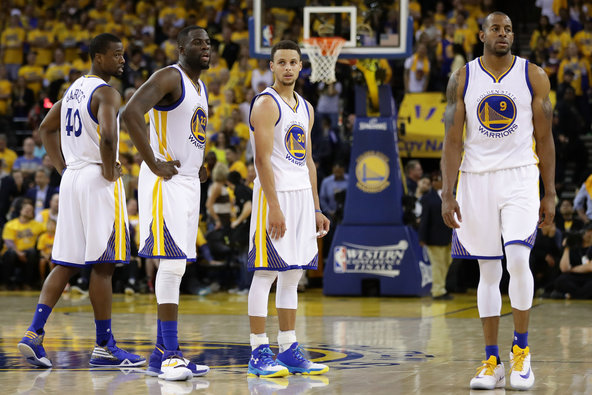
For an extended period, big men clearly dominated the NBA and basketball in general. It remains evident that a higher skill level combined with size typically provides a significant advantage. The preference is to have both attributes when given the choice. Having a player like LeBron James handling the ball or Kevin Durant on the wing undeniably enhances any team. The combination of size and skill tends to outmatch lesser attributes. However, recent trends have showcased deviations from this norm. A prime example is the Warriors’ promotion of the “Death Lineup,” featuring a center standing at 6’6″ in Draymond Green, who demonstrated sufficient defensive skills to cover for it, enabling them to field a highly dynamic and skilled team.
Teams with diverse player compositions can still succeed if they possess exceptional talent. As an exercise, I believe that during the 90s, a team with players like Charles Barkley at center, complemented by top-tier talent, could have achieved victory. At some point, being good enough is sufficient. Such a team could dominate on offense. Even the Bulls were early adopters, playing Dennis Rodman at center and Toni Kukoc against players like Shaq.
2014-Present
There was a phase in basketball where it seemed that smaller teams were achieving higher levels of success. As a general rule, teams often fielded their best lineups with a smaller version of their key players, playing them up a position or two. It was not uncommon to see players like LeBron James or Kevin Durant at center, and Kawhi Leonard at power forward, among others. This trend allowed teams to have highly skilled players on the court by leveraging star players’ ability to play multiple positions. I even recall the Denver Nuggets backcourt featuring Ty Lawson (5-11), Nate Robinson (5-9), and Randy Foye (6-4) on the court together, something that would have been unthinkable in the 1990s.
In more recent times, there has been a resurgence of highly skilled big men, exemplified by players like Nikola Jokic and Joel Embiid. However, during playoff runs, Embiid has faced criticism for his defensive challenges when opposing teams opt for smaller lineups, attempting to draw him out to the perimeter. This tendency becomes particularly prevalent during crucial moments, commonly referred to as “winning time.” It seems that nearly all teams, whether in the NBA or college basketball, tend to shorten their rotations and deploy smaller, more skilled lineups when the game’s outcome hangs in the balance. This strategy appears consistent across both the NBA and college basketball. Even when a dominant player like Embiid anchors the team, it becomes challenging to shield them defensively, as opponents can exploit smaller matchups, potentially diminishing their effectiveness or even leading to their exclusion from the game.
Nevertheless, despite potential defensive mismatches, players like Embiid are never sidelined because their skill level demands they play and assert dominance on offense. In recent times, there has been a resurgence in larger teams, putting pressure on opponents attempting to downsize. Players like Jokic, as seen in last year’s playoffs, have been able to dictate the game due to their exceptional skills. However, it still seems that smaller players find it easier to take charge during critical moments and influence how many teams, especially those without elite bigs, have to play. Most traditional bigs still aren’t closing games.
One perplexing aspect is why teams don’t adopt this downsizing strategy throughout the entire game. Historically, teams might have a center playing 15 or 20 minutes a game, but when it’s “winning time,” they downsize and substitute a wing player or guard. Andrew Bogut serves as an example of this approach—starting big and finishing smaller.
2023-2024
The most dominant lineup so far this season, having played over 100 minutes together, consists of N. Batum, T. Harris, J. Embiid, D. Melton, and T. Maxey. They have logged 219 minutes together and boast an impressive +34 NET rating. The next closest lineup features K. Durant, E. Gordon, J. Nurkic, D. Booker, and G. Allen, playing 110 minutes together with a +26.8 rating.
In contrast, the best lineup from last season’s regular season comprised S. Curry, K. Thompson, D. Green, A. Wiggins, and K. Looney. They played 331 minutes together and achieved a +21.9 rating. Although not quite the historic Death Lineup of old with Looney still in the mix, it remained a formidable combination.
The Death Lineup during the 73-win season stood out as the best lineup in the league with over 100 minutes played. Deployed in 37 games, it featured A. Iguodala, S. Curry, K. Thompson, H. Barnes, and D. Green, playing 172 minutes and boasting an impressive +40.2 rating. This lineup saw increased action during both playoff runs in 2015 and 2016, with significant playing time in each postseason.
In recent playoffs, big men in the NBA have experienced a resurgence, with players like Jokic, Embiid, Anthony Davis, Bam Adebayo, and Brook Lopez making impactful contributions. The trend toward playing smaller lineups has become less viable than it was 5 to 10 years ago.
College
The convergence of Covid 5th-year super seniors, NIL money, and transfer freedom has ushered in an era for bigs in college basketball that hasn’t been witnessed in quite some time. Many ground-bound centers, who would typically have moved on to professional basketball or become second-round draft picks, are choosing to stay in college due to the opportunities presented by NIL money. For some, the potential earnings in college surpass what they could make in the NBA, G League, or Europe. In recent years, college basketball has been predominantly influenced by players like Zach Edey, Drew Timme, Oscar Tshebwe, Armando Bacot, and Hunter Dickinson—players who might have opted to leave sooner in a different era.
UConn’s dominant run to the championship last season was undeniably anchored by Adama Sanogo, with assistance from Donovan Clingan. Both players delivered outstanding performances, covering all the center minutes. In contrast, the 2022 champion Kansas started Jalen Wilson at center, who was only listed at 6-8, 215, with freshman Gradey Dick, listed at 6-8, 205, as the other big forward. Notably, when Wilson measured at the combine, he was only 6-6, 220. The Jayhawks’ only player with significant size, Ernest Udeh, played in 30 games, averaging 8.3 minutes per game. The 2021 champion Baylor also featured an undersized lineup. While they platooned their big man rotations, their tallest player at 6-10 played only 15 minutes per game. They even started a 6-5, 250lb power forward alongside three smaller guards measuring 6-2, 6-3, and 6-4 on the perimeter.
Conclusion
For a period, we witnessed a shift towards smaller lineups, particularly in crunch time in the NBA. This trend appears to persist as the preferred lineup, unless elite bigs are on the court. In college basketball, ground-bound post players seem poised to become a staple moving forward. Previously, before the era of NIL and when players made no money (legally) off college basketball, there was an incentive for them to move on to professional basketball. However, the landscape has changed, and those with less NBA appeal are now in no rush to transition. In many cases, they can potentially earn just as much money, if not more, by staying in college rather than moving on overseas or to the G League.