“Everybody’s recruiting top-50 guys,” Mark Few said “Well, they’re still 18, and they’re going against 23-year-olds.”
In Duke’s case the top two will be 17 years old, or a couple months removed from it when the season starts. Per KenPom, only five of the top 100 players in offensive rating are true freshmen. In the 2018-19 and 2019-20 seasons, that number was 14. Last season, there were only two freshmen in the top 100. Playing time has remained roughly the same since 2020, though in 2019 nine freshmen ranked in KenPom’s top 100 players in percentage of minutes played — this season, there are two.
Duke roster rebuild is nearly complete. With the high expectations that come with Duke’s program, these transfers seem completely underwhelming, and I remain highly skeptical of this team’s build in the super senior transfer-free age. To be so heavily focused on freshmen, even with reclassified high school juniors vs. 23-year-olds, is malpractice. No doubt people will still rank Duke in the top 5 by many, but let’s actually dig into what to expect from this roster.
Questionable Transfer Decisions
The most recent transfer is Cameron Sheffield from Rice, who missed the entire last season due to a foot injury. In his last active season, Sheffield averaged 7.6 points and 6.2 rebounds per game in CUSA. His 12.0 PER and limited offensive role, taking only five shots on average per game over 31 minutes. Even as a last resort, you’d think Duke could get someone better, and I still think they needed someone better. Duke could still have injuries or inevitable bust in your freshmen class and need a contributor. Even McNeese State landed better end of the bench guys on their roster from the portal. Most good teams did.
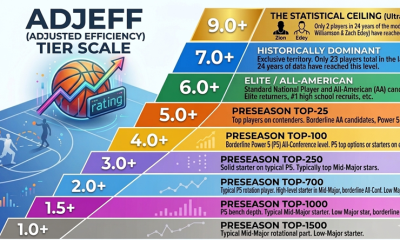
Duke easily secures top high school talent, but it seems to struggle with transfer recruits. Choices like Sheffield feel more suited for mid-major programs. Similar concerns apply to the other transfers as well. Even with Maliq Brown, whom my model loves more than any ranking system out there, but he comes with poor three-point shooting and fit issues. The most notable transfer, Sion James, is a player with an 18 PER from a losing Tulane team. This is a transfer class more fitting from top mid-majors or mid-to-lower power conference programs. It’s solid, but not for Duke.
| ADJeff | PER | 3pt | 3% | ||||
|---|---|---|---|---|---|---|---|
| So | 6-8 | Maliq Brown | 4.6 | Syracuse | 22.0 | 7-19 | 0.368 |
| Sr | 6-6 | Mason Gillis | 3.1 | Purdue | 15.5 | 58-124 | 0.468 |
| Sr | 6-5 | Sion James | 2.7 | Tulane | 18.0 | 43-113 | 0.381 |
| Jr | 6-6 | C.Sheffield | 1.6 | Rice | 12.3 | 44-118 | 0.373 |
Outside of Sion James, the other three were their teams’ 5th or worse scorers. James himself played on a 5-13 AAC team. Also, I really thought they most needed another point guard. Sion James is the big transfer star by most media rankings out there, but for example, his teammate Collin Holloway who was pretty similar statistically, is going to Samford and no one ranks him anywhere near at top 100. James is solid but he’s not one of the best transfers.
| Maliq Brown | Syracuse | 9.5 Pts, 7.2 Reb, 1.8 Ast |
| Mason Gillis | Purdue | 6.5 Pts, 3.9 Reb, 1.7 Ast |
| Sion James | Tulane | 14.0 Pts, 5.4 Reb, 2.7 Ast |
| C.Sheffield | Rice (2023) | 7.6 Pts, 6.1 Reb, 1.3 Ast |
The Risks of Relying on Youth
Recent seasons have shown that even highly recruited Duke freshmen can underperform. Whitehead and Lively, who were ranked 1st and 2nd in their class, averaged only 5ppg. Injuries and the unpredictability of freshman performance add to the uncertainty. While elite high school recruits bring upside, they also bring bust potential, and banking solely on their success is risky without high-level proven collegiate players for stability.
Moreover, this strategy overlooks the benefits of experienced transfers who can offer leadership. The idea that Duke should settle for mid-major level transfers would be troubling if I were a fan because the program should consistently attract the best available talent. It seems part of this is keeping the path to minutes clear for their freshmen. To me, that’s a big loser if you want to compete for championships in the transfer-free age where the best teams get old and stay old while consolidating the best mid-major and lower-level P5 talent yearly. Just look at the best in the business right now UConn, and what their last two roster have looked like. It’s nothing like what Duke is doing.
The Impact of NIL and Transfer Portal
Another factor is the trend of players staying in college for Name, Image, and Likeness (NIL) money instead of going pro. Typically, the ground-bound post players like Armando Bacot or Hunter Dickinson that would leave early now stick around all 4 or 5 years. High school players like Flagg will be competing with players like that or 24-year-old DJ Burns.
The returning starting experience on Duke is Tyrese Proctor, as we predicted, didn’t come close to meeting the hype last year. Proctor, along with Caleb Foster, now has to lead the team and set the ton for the incoming high schoolers and transfers. Those are your culture-proven returning pieces.
| Returners | |||
|---|---|---|---|
| Tyrese Proctor | Jr | 6-5 | 10.5 Pts, 3.0 Reb, 3.7 Ast |
| Caleb Foster | Fr | 6-5 | 7.7 Pts, 2.4 Reb, 2.1 Ast |
Cooper Flagg: A Prodigy with Challenges
| Rank | ||
|---|---|---|
| Cooper Flagg | 1 | 6-9 |
| Khaman Maluach | 3 | 7-1 |
| Isaiah Evans | 12 | 6-6 |
| Kon Knueppel | 17 | 6-5 |
| Patrick Ngongba II | 18 | 6-11 |
| Darren Harris | 51 | 6-6 |
Cooper Flagg played for an impressive high school team. His high school team, with five players ranked within the top 25 recruits, mirrors Duke’s potential core lineup. However, his stats suggest he blended in rather than stood out, raising questions about his readiness to excel in college, especially against older players.
Flagg, reclassified to enter the 2025 NBA draft, will face physical challenges due to his young age and lighter frame. He’s basically the equivalent of a high school junior who will be competing against many 22 to 24-year-olds next year. His performance may not even match his high school stats of 16.5 PPG, 7.5 RPG, 3.8 APG, and 2.9 BPG, especially given the physicality of college basketball, and the fact that he is 200lbs playing mostly around the rim.
| Year | MPG | PPG | RPG | APG | SPG | BPG |
| 23-24 | – | 16.5 | 7.5 | 3.8 | 1.6 | 2.7 |
| 22-23 | 17.8 | 9.8 | 5.2 | 3 | 1.6 | 2.2 |
| 3PM | 3PA | 3P% | FTM | FTA | FT% | 2FG% |
| 36 | 96 | 38 | 85 | 109 | 78 | 61 |
| 18 | 48 | 38 | 26 | 30 | 87 | 62 |

Khaman Maluach: The Key to Duke’s Season
Khaman Maluach doesn’t turn 18 until late September and is also very young. However, I am intrigued by him. Unlike Flagg, he actually has the size at 250 where he should be able to compete. He has also played against grown men already and dominated, averaging 19.11 PPG, 14.2 RPG, and 3.1 BPG with a 23 PER at the NBA Africa Academy.
I looked up the level of competition and there were many players in the league that had played in college, including a former Baylor All Big 12 player Jo Acuil who was 30 years old and 37 year old Hasheem Thabeet among others. I would expect Maluach to play very well, and he may be the key for Duke. If they exceed my expectations it’s probably because he made a huge impact and was a force from day one.
The Need for Proven Talent
Duke’s talent influx is undeniable, with many future NBA picks likely among their recruits. However, the question remains whether these freshmen will be ready to lead a top team next season. The unpredictability of freshman performance contrasts with the reliability of experienced transfers. For example, Kentucky’s team last year, which had a mix of top freshmen and much more proven veterans than Duke has, finished only 23rd on KenPom. They had two of the best freshmen in the country playing out of their minds, shooting ridiculous percentages like Reed Shepard. Shepard wasn’t even the freshman anyone expected anything from. How bad would it have been if he didn’t emerge and shoot 52% three-point range?
Rotation
| C | Khaman Maluach | Fr | 7-1 | 3 (19.11ppg, 14.2rpg HS) |
| F | Cooper Flagg | Fr | 6-9 | 1 (16.5ppg, 7.5rpg HS) |
| F | Maliq Brown | Jr | 6-8 | 9.5 Pts, 7.2 Reb, 1.8 Ast |
| G | Tyrese Proctor | Jr | 6-5 | 10.5 Pts, 3.0 Reb, 3.7 Ast |
| G | Caleb Foster | So | 6-5 | 7.7 Pts, 2.4 Reb, 2.1 Ast |
| 6th | Sion James | Sr | 6-5 | 14.0 Pts, 5.4 Reb, 2.7 Ast |
| 7th | Mason Gillis | Sr | 6-6 | 6.5 Pts, 3.9 Reb, 1.7 Ast |
| 8th | Isaiah Evans | Fr | 6-6 | 12 (27.6ppg 6.3rpg HS) |
| 9th | Kon Knueppel | Fr | 6-5 | 17( 25.9ppg 8.3apg HS) |
| 10th | Patrick Ngongba | Fr | 6-11 | 18 |
| 11th | C.Sheffield | Jr | 6-6 | 7.6 Pts, 6.1 Reb, 1.3 Ast |
| 12th | Darren Harris | Fr | 6-6 | 51 |
One thing that no one can deny is Duke is big. I also think Flagg’s best skill right now is his shotblocking, even if I would expect him to be bullied some inside by players 5 and 6 years older than him. Duke’s best path to success seems like leveraging all this size to have an elite defense. Kon Knueppel and Isaiah Evans are intriguing sleepers, and it’s certainly possible you could get freshmen that come from nowhere like Reed Shepard did, but you shouldn’t have to rely on unknowns exceeding expectations at Duke. I also don’t know why you’d ever sign the 51st player if you are Duke as the 6th freshman in a class, much less in the super senior era with hundreds of good transfers. There are probably 250 transfers that are better than the 50th ranked freshmen.
Conclusion
While Duke brings in exceptional talent, the uncertainty surrounding freshman contributions and the evolving college basketball landscape mean that there is more weight than ever on the strategic use of the transfer portal, especially in the last year of super seniors. These are essentially high school juniors for all intents and purposes with 5th year players still around. Talented, yes, but this is still a real experience deficiency. I also worry that the one core returner in Proctor will be given the most usage and shots, and I think he remains completely overrated for that role. For Duke to maintain its elite status, I don’t think this was the path to be a serious contender this year.


College Basketball
2026-27 Preseason College Basketball Projections: AdjEff Model

College Basketball
2026-27 Preseason College Basketball Player Ratings: AdjEff Model

College Basketball
Refining the Lens: The 2026 International-to-NCAA Translation Model


College Basketball
Transfer Portal Basketball Rankings 2026

College Basketball
Transfer Portal Basketball Rankings 2026
College Basketball
2026-27 Preseason College Basketball Projections: AdjEff Model
College Basketball
2026-27 Preseason College Basketball Player Ratings: AdjEff Model


College Basketball
Summer Clearance: Bargain Bin Shopping in the Portal


College Basketball
The Top 300 Returning Players

College Basketball
Top 200 transfers by Adjusted Efficiency