It’s no secret that nearly all college basketball teams live and die by their offseason moves, especially in today’s transfer-heavy landscape. Yet, year after year, we see programs struggling in key addressable areas like shooting, rebounding, or overall depth. Meanwhile, talented players—players who could’ve at least addressed these very weaknesses—slip through the cracks and land at low-major programs or unimpressive schools.
This article examines some of the overlooked transfers from our rankings last year’s who easily had the talent and potential to contribute at mid- and lower-tier Power 5 programs and that went to mid an low major ones. These are the kinds of players your coach should have recruited—athletes who were, identified as impactful pieces, but weren’t brought in. Granted sometimes the little guy has a tie to a player or just wins the recruiting battle. That said I think it’s obvious a lot of the time it’s just poor roster construction, fit, or philosophy and what to look for for certain coaches.
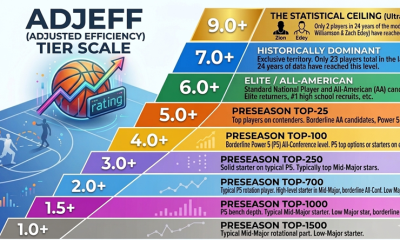
Below, we’ll break down the players who could’ve changed your team’s trajectory. After that, we’ll draw some conclusions about why these misses were so obvious and how they could have been avoided. The players were ranked in our offseason transfer rankings model by ADJeff, and were in the preseason top 600. They shouldn’t have been hard that hard to identify.
Looking at these players, the pattern is clear: these were obvious pickups that could have made a tangible impact on mid- and low-level Power 5 teams, helping to fill gaps and weaknesses. Indiana, you needed some shooting—why not add a Davion Bailey, who was transferring from in-state Ball State and going to Incarnate Word? Why was this not an obvious take for a team that needed three-point shooting? It seems like low hanging fruit near the back half of the roster.
Why wouldn’t a Jalen Terry have been a better fit for a team like Rutgers instead of Derkack or Acuff? Terry made three-pointers in the Big East; there was no question he could provide better spacing with the threat he posed. Instead, they reportedly gave Acuff $250K from Eastern Michigan after he shot 29% from three there, while Jalen Terry replaced him there and likely went to Eastern Michigan for little to nothing. This was after shooting 45% on a much higher volume in the Big East. It makes no logical sense—it’s just a coach who historically doesn’t value three-point shooting at all. How did no P5 coach grab him to sure up their shooting. He even had a top 70 recruiting pedigree, some coaches usually over value years later.
How good of a team could you have built from scratch with just this pool of players?
This could have been a starting lineup. (Miller plays about 6 minutes a game with another 7 footer)
Essentially, in our model, you could have built a top-60 talent team just based on the previous year’s stats. A team currently led by players like Cluff and Parker, I think, would have that talent level as well. I’m thinking about this more from an ancillary talent perspective, however. What could a team like UNC have done with Cluff—assuming they actually played him, unlike Ven-Allen Lubin? These were players that could have been elite role players on the top teams or that P5 teams like Seton Hall, Boston College, or Virginia Tech could have built their entire rosters around and likely been much better off. The same holds true for high-resource mid-majors struggling. This assumes competent in-game coaching and rotations. Finding players like this is part of coaching as well.
These players weren’t hidden gems or high-risk gambles; their production, skill sets, and potential were evident for anyone paying attention. The fact that these players ended up at low-major or unimpressive schools isn’t a reflection of their abilities—it’s a reflection of poor scouting, evaluation, or a lack of strategic recruiting by the programs that needed them most. Whether it’s filling gaps in shooting, rebounding, or depth, these players were tailor-made solutions sitting in plain sight.
If your team is struggling, it’s worth questioning whether the coaching staff was asleep at the wheel. In today’s game, where transfers can immediately change a program’s trajectory, failing to identify and recruit these kinds of players is a major misstep. The tools to find talent are there and even lower level P5’s should have been able to win some of these recruiting battles.