When we talk about national title contenders, it’s easy to get caught up in the top-end talent — the All-Americans and projected lottery picks. But every year, injuries, foul trouble, and fatigue separate the teams that can sustain success from those that crumble under pressure and injuries. We wanted to quantify depth in a more meaningful way, not just “who has bodies,” but who actually has good players beyond the starting five.
The Process: Measuring Depth Beyond the Starting Five
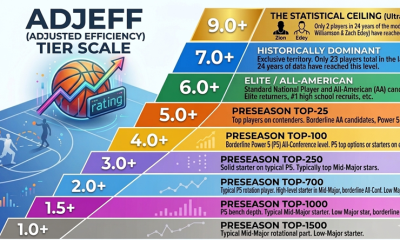
Because it’s still early in the preseason and starting lineups haven’t solidified, we evaluated depth by isolating each team’s 6th through 10th ranked players in the rankings using our model — a rating system that adjusts for strength of schedule, efficiency, and per-possession impact.
This gives us a truer sense of bench quality rather than roster size alone. Some teams have nine or ten playable guys, while others barely have six proven players who project as positive contributors. The goal was simple: identify the most injury-resistant teams in college basketball — the ones that can lose a starter or key bench guy and keep rolling.
Rank
Team
Bench Rating
🥇1
Vanderbilt
4.3
🥈2
Texas A&M
4.2
🥉3
Auburn
4.1
4
Arizona
3.9
5
Louisville
3.8
6
Illinois
2.7
7
Kentucky
3.7
8
North Carolina
3.6
9
St. John’s
3.5
10
Houston
3.4
11
USC
3.2
12
SMU
3.1
13
Gonzaga
3.0
14
Virginia
3.0
15
Iowa State
2.9
Teams Built for the Long Haul
1. Vanderbilt
Vanderbilt grades out with one of the most complete benches in the country. Their depth includes multiple players after the top 5 still rated between 2.4 and 2.7 in our model or 300 to 400th nationally — guys like Tyler Tanner and Jalen Washington who could start on a lot of mid-tier teams. It’s the kind of roster that can weather injuries and still field balanced lineups.
Few teams combine the bench quality like the Aggies. Their second unit could likely be a top 100 team. Marcus Hill will likely come off the bench and he’s put up 20ppg and 5rpg in D1 before and 11.5ppg and 3.9rpg with a 16.3 PER for an ACC team last year. He might realistically be played like their 9th man. Ali Abdou Dibba was an 18ppg 5rpg player in the MVC as well and likely deep in their bench. If Jacari Lane starts that likely pushes Rylan Griffen to the bench as well. Bucky McMillan likes to play a deep bench and this might be the one time where it’s justifiable with so many players in a similar general range. He has the luxury of rotation flexibility that most coaches would kill for and it’s pretty impressive taking the job later in the cycle and assembling the depth he did. There are really players here all the way until the 14th spot on the roster that are interesting or could compete for minutes.
Even after losing stars to the draft, Auburn remains loaded. Abdul Bashir likely coming off the bench and he averaged 27ppg in Junior College. Filip Jović as well who averaged 12ppg in the ABA and comes up 125th in the nation in our model. There aren’t as many proven players on this team, but it’s more the quality here that carries the day.
4. Arizona
Arizona’s depth might be its greatest weapon if all the freshman talent performs as well as it’s projected. The simple fact they might bring Tobe Awaka off the bench already makes this a super star bench. Regardless who is starting this team will have someone with accomplishments or accolades coming off it. this season being established players like Anthony Dell’Orso, or new internationals like Sidi Gueye, and Ivan Kharchenkov all rate as quality rotation players. In a season where foul trouble or fatigue can swing a Pac-12 game, the Wildcats have multiple capable backups ready to step in.
Teams Just Outside the Top Tier
Louisville
The Cardinals boast high-end bench talent in Isaac McKneely or Adrian Wooley coming off the bench which ever doesn’t start, and Aly Khalifa, both near the 3.0 mark. Unfortuantly the way Kelsey likes to over play his bench particularly the 9th and 10th men where they aren’t as strong I’m not sure that’s a good thing. The only year he’s done something at the level of the talent was when injuries took the 8th through 11th men he’d rather play away from him.
Illinois
Illinois would be firmly in the top five here if not for the injury to Ty Rodgers. Before his setback, the Illini had three bench players rating near 3.0 in our model all top 275 players nationally with — David Mirkovic, Ben Humrichous, and Rodgers himself. Even without him, Illinois still ranks highly for quality depth, but his absence highlights just how fragile balance can be. Humrichous started last year and if he’s still starting that means Zvonimir Ivisic will be coming off your bench and he’s 116th in the model.
Kentucky
Kentucky’s bench combines raw talent with potential with freshmen like. Jasper Johnson and Malachi Moreno or even starters on national champions like Denzel Aberdeen depending on the direction they go in the starting lineup to headline a second unit full of future breakout candidates. The Wildcats’ upside remains enormous if even one or two of those players exceed expectations.
North Carolina
If you have a 14 million dollar roster you better have a depth of multiple playable options if you don’t have the stars. Some are a little quationable but their are plenty of highly recruited freshmen and players that have been in rotations after the top 5. Jarin Stevenson and Jonathan Powell both grade well in our system for 7th or 8th men type and provide flexibility at multiple spots. The Tar Heels have a strong blend of youth and experience that should pay off late in the year. I recently wrote what I would have done differently, but these are still a respectable bench.
St. John’s
Rick Pitino’s group has one of the better guard-heavy benches in the country. Oziyah Sellers (2.7) leads a deep mix of perimeter players that can plug in without a major drop-off. If he’s your 7th best player and still like a proven top 300 type of player you are in good shape. I don’t see the high end outcomes some do, but the floor is rock solid here.
Kelvin Sampson’s teams are built on toughness and defense, and this year’s depth fits that identity. Kingston Flemings headlines a group that also includes Jacob McFarland and Kalifa Sakho, coming off the bench. Houston’s system relies on energy and rebounding, and having multiple interchangeable guards and forwards ensures no drop-off when the bench is called upon. This is a roster designed to absorb wear and tear over the course of a long Big 12 schedule. It’s probably the most plug and play system there is, so I think you have to trust Sampson here even if on paper this is more projection from freshmen. He gets his type of guys and never seems to miss a beat. It also stands to reason a top 2 team has a good bench, but I do have more questions than last year.
USC
USC might not have the star power of last year, but they might be deeper. Multiple guys form a solid second wave behind a but talented starting five. This is the deepest Trojan roster in recent memory — capable of mixing and matching lineups depending on matchups. This is what Eric Mussellman does, take a bunch of talent and let the best man emerge and win the minutes. If you have guys like Jaden Brownell or Jacob Cofie outside a top 5 you are in pretty solid shape.
Under Andy Enfield, SMU has quietly built one of the more complete benches outside the Power Five. Nana Owusu-Anane and Sam Walters lead a group of experienced and athletic role players. The Mustangs may not have elite top-end talent, but the model loves how consistent their 6–10 range is. That balance could be a huge factor if they make a run through the ACC — they simply don’t rely too heavily on any one player and could take an injury or two and be fine as long as it’s not Boopie.
Mark Few’s Zags are always well-stocked, and this year is no exception. Tyon Grant-Foster brings veteran scoring and could be their 6th best player or come off the bench. If it’s some one else Gonzaga’s bench may not have a star, but its balance and reliability and proven mid majors should make it one of the hardest groups to exploit. When you combine experience with system continuity, you get one of the most stable benches in the country with guys like Steele Venters and Braeden Smith who have been there learning at least if not playing.
Ryan Odom’s Cavaliers will start out as a likely deep unity, and that extends to the bench. Jacari White and Sam Lewis all project as steady contributors who can step in without disrupting the team’s identity. Virginia’s bench mirrors its starters — low-variance, low-mistake players who execute. That makes them particularly resilient to injuries or foul issues, even if the scoring ceiling is limited.
T.J. Otzelberger’s Cyclones are one of the nation’s most rugged defensive teams, and they have the depth to maintain that pressure for 40 minutes. Dominykas Pleta, , and Eric Mulder headline a bench that’s physical, and unselfish. Iowa State’s overall talent is middle-tier, but their rotation depth gives them an edge in grind-it-out Big 12 games — especially late in the season.
The teams listed here aren’t necessarily the most talented overall — they’re the ones most capable of surviving adversity. A deep bench doesn’t just help with injuries; it allows for lineup experimentation, defensive intensity, and sustained pace. For example Washington would have squeaked into this list if Jacob Ognacevic hadn’t already gone down this week with injury.
The model makes clear that depth quality matters as much as quantity. Having eight or nine playable players who all rate above a 2.0 gives a coach flexibility that’s critical over a long season. Vanderbilt, Texas A&M, Auburn, and Arizona exemplify that balance between talent and stability.
When Depth Becomes a Double-Edged Sword
Depth can be both a blessing and a curse, and few coaches embody that paradox more than Pat Kelsey. On paper, having 10 or 11 playable guys sounds ideal — injury insurance, competitive practices, and fresh legs. But in practice, it can become a self-inflicted handicap when a coach tries to keep everyone happy or just likes playing fast and justifies it instead of leaning into his stars. Kelsey’s track record shows exactly that. He’s developed a pattern of spreading minutes too thin in my opinion and it shows in his teams historical rankings (1 top 100 team -71st- in 12 years as a coach prior to last year), routinely giving his best players 19–22 minutes per game while the ninth and tenth men get regular rotation 8 to 10 minutes of time. When you trade 10 minutes of your All-Conference big man for your tenth man, you’re simply lowering your team’s ceiling.
The irony is that last year’s injuries might have actually saved Kelsey from himself. With only seven healthy players at one point, he was forced into a tighter rotation — and suddenly, his team played with more rhythm, chemistry, and consistency. Players like Ante Brzovic and DJ Burns, who were previously trapped in less than 20-minute roles, started producing like the stars they actually are. Louisville didn’t have the luxury to overthink lineups, and the results spoke for themselves. They played freer, without the constant worry of being pulled after a single mistake, and the offense flowed more naturally. It’s a reminder that sometimes less really is more.
This isn’t an isolated pattern. At College of Charleston, Kelsey’s teams often went 10 or 11 deep, even when the talent drop-off after the top five was steep. Those extra minutes for the bench came at the expense of his best players — a recipe for underachievement when rankings and tournament seeding depend on maximizing win margins. It’s not that Kelsey can’t coach — his teams play hard and deep — but he’s often too democratic with his minutes in a sport that rewards hierarchy. When you have an All-Conference player like DJ Burns or Brzovic, you don’t cap them at 15–20 minutes a night. DJ Burns was All Big South one year playing 15.7 minutes a game. You let your best guys carry you, not your eleventh man. Injuries at Louisville forced last year, but without them, history suggests he’ll go right back to over-managing depth and underplaying his stars — the classic case of depth becoming a double-edged sword.
Final Thoughts
It’s easy to focus on stars when predicting success, but as every March reminds us — one ankle turn or foul-prone big can change everything. The teams above have built rosters designed to withstand those moments.
And while preseason projections can only tell us so much, the data already hints at which programs have the built-in resilience to survive the marathon ahead. In college basketball, durability is often destiny — and these benches might just be what separates contenders from pretenders.